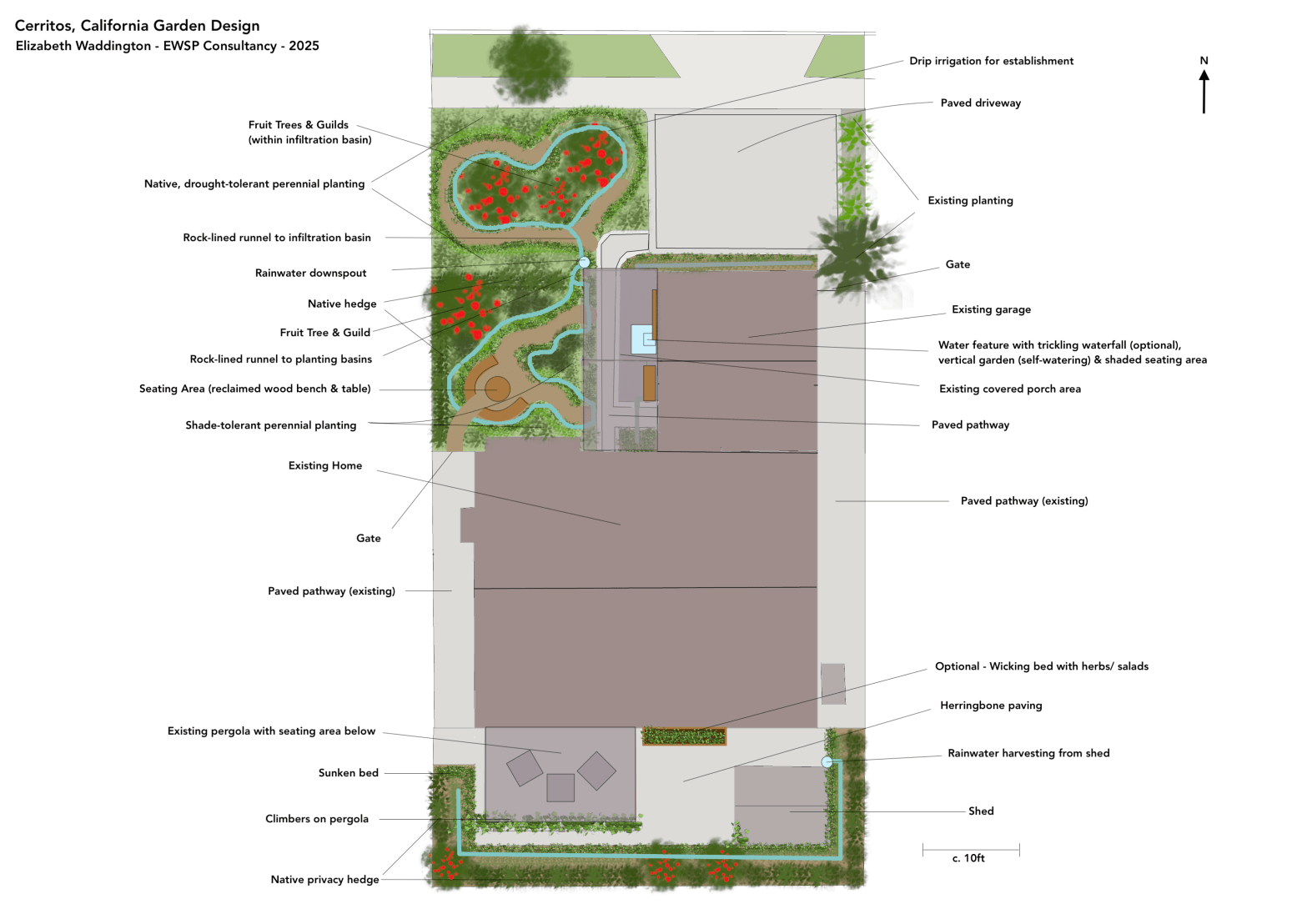
Cerritos has a warm-summer Mediterranean climate with mild, wet winters and warm, dry summers. Average annual precipitation is about 12–14 inches, most falling November–March. The soil conditions are characterised by good drainage, modest natural fertility. There is a need for irrigation in summer, and occasional soil amendments (of organic matter) to boost water-holding capacity and fertility.
This landscape design is deliberately structured to capture, slow, store, and sink water onsite while using drought-tolerant native plants to minimize irrigation demand. The design intentionally avoids areas of lawn turf, replacing it with permeable soils, mulched planting beds, and pathways. Removing lawn eliminates one of the highest water-demand elements in a typical California garden.
The design suggests the use of California native shrubs, perennials, grasses, and trees—plants that are adapted to Cerritos’ Mediterranean climate and summer drought, require little to no supplemental irrigation once established, and support local ecology and pollinators.
Fruit trees, with somewhat higher water demand, are placed within infiltration basins, ensuring they get deeper periodic moisture while minimizing summer irrigation needs.
A simple drip irrigation system is included to help plants get established in the first year or two. After that, most plants will need only occasional deep watering. Drip irrigation delivers water directly to the roots, reducing waste and evaporation.
FRONT YARD Northern Section:
A key feature of the front yard is the rainwater-harvesting system. The subtly sculpted infiltration basin forms the heart of the design. A rock-lined runnel guides rainwater from the house’s downspout into the garden.
During storms, the basins – deepest around fruit trees, will temporarily fill, allowing water to slowly soak into the soil rather than run off the property. This deep watering supports fruit trees etc. while greatly reducing the need for supplemental irrigation.
Softly curving planting beds and a wood chip pathway create a natural flow through the space, filled with drought-tolerant California natives and carefully designed fruit-tree guilds.
Each fruit tree is surrounded by a guild: a community of companion plants chosen to support the tree and the broader garden ecosystem. Together, the fruit tree and its companions form a mini-ecosystem that is resilient, low-maintenance, and highly water-efficient.
Rock Lined Runnels:
- Width: 12–18 inches
- Depth: 4–6 inches (shallow, to encourage infiltration rather than channeling)
- Slope: Gentle, approx. 1–2% grade
- Lining:
- 1–3 inch river rock on the surface
- Optional small gravel base for stability
- Edges: Softly shaped soil berms or planting edges that help contain and visually blend the runnel into planting beds
Infiltration Basins:
The two northernmost fruit trees share one large, shared infiltration basin that gently spans the planting area and includes three low points (“tree dips”), each placed at the base of a fruit tree.
Rainwater enters through the runnel:
- The outer 4-inch contour fills first, slowing water down.
- Water naturally spills into the 8-inch inner contour.
- Finally, water settles into the 10–12 inch tree dips, giving the nectarine and orange the deepest watering.
- All levels are sloped gently so water flows smoothly without erosion.
Wood-chip mulch is used across all contours to retain moisture, regulate soil temperature, and protect the basin from erosion. Mulch is kept away from the tree trunks to prevent rot. Companion plants around each tree help stabilize soil, attract pollinators, and improve water use efficiency.
Irrigation
The drip irrigation in the front basin is designed to support the plants during their establishment phase while working together with the basin’s rainwater-harvesting system. Because this area receives deep periodic watering from rainfall, the irrigation system is simple, low-flow, and highly targeted.
The purpose of the drip system is to:
- Provide consistent moisture during the first 1–2 years while young trees and native perennials develop strong root systems.
- Deliver water slowly and directly to the soil, limiting evaporation and runoff.
- Supplement natural rainfall without overwatering the basin.
- Become occasional-use only once plants are mature (especially natives).
FRONT YARD Southern Section:
In the other area of the front yard, south of the hedge, gentle earthworks/ contouring can be used in a similar way to gently direct water after the second short rock lined runnel, though drought tolerant planting here means that any contouring need not be as deep.
This portion of the front yard includes the native privacy hedge, the Western redbud, and a mix of drought-tolerant perennials and shrubs planted along the pathway leading to the home.
This portion of the front yard sits directly north of the home, forming a sheltered, semi-enclosed garden space between the house and the larger infiltration-basin planting. It acts as a transition zone: quieter and more intimate than the main front garden, but still visually connected to it.
Directly south of the redbud is a small, informal seating nook, furnished with a reclaimed wood bench or simple garden furniture. The seating area is framed by low, native perennials and subshrubs that keep the shaded space feeling open while still lush.
The drip irrigation here is designed to support establishment while respecting the low-water needs of California native plants.
BACK YARD
An existing pergola here anchors the space and provides a sheltered outdoor seating area. Beneath it, herringbone paving provides a space for outdoor entertainment. (I would recommend permeable paving if possible.)
The pergola also helps cool the adjacent patio and house wall while creating an inviting transition between the home and the garden.
(I have recommended a native climber here in place of wisteria, but I would be happy to discuss other climber options in additional consultancy for my usual hourly fee. )
Just beyond the pergola is a sunken planting bed. Lowering this portion of soil (just a few inches) allows it to collect incidental runoff and hold extra moisture, supporting shade-tolerant native plants. This creates a green buffer along the edge of the patio and adds softness to the seating area.
The shed roof is used as a small rainwater-capture source. Water is directed toward the planting area via a short runnel or pipe, helping irrigate the privacy hedge and reducing the need for supplemental watering. This makes the most of natural rainfall and reinforces the garden’s overall water-wise approach.
Along the outer southern boundary, a dense native hedge creates a living screen. This hedge offers privacy, blocks some noise, and forms a green backdrop for the rest of the garden. Seasonal flowers, berries, and foliage changes increase wildlife value and add color through the year.
Near the house wall is an optional wicking bed – a self-watering planter that uses a built-in reservoir to grow herbs or salads with minimal irrigation. This offers a practical way to grow edibles close to the kitchen while keeping water use low.
If you are interested in discussing a water-wise garden design for your own property, please contact me for a bespoke quotation.
 EWSP Consultancy