Happy New Year! Back to work and ready to go, I am excited to work on more permaculture projects over the year to come. From home gardens to farms, community projects to regenerative rewilding schemes, I am excited to discover more amazing people, places, and projects over the coming months.
This is a time of year when many of us (myself included) are setting goals for the future. As a new year begins we inevitably find ourselves looking forward, dreaming, and imagining what could be. Effective goal-setting can be important to help us to find and set out along a pathway to success.
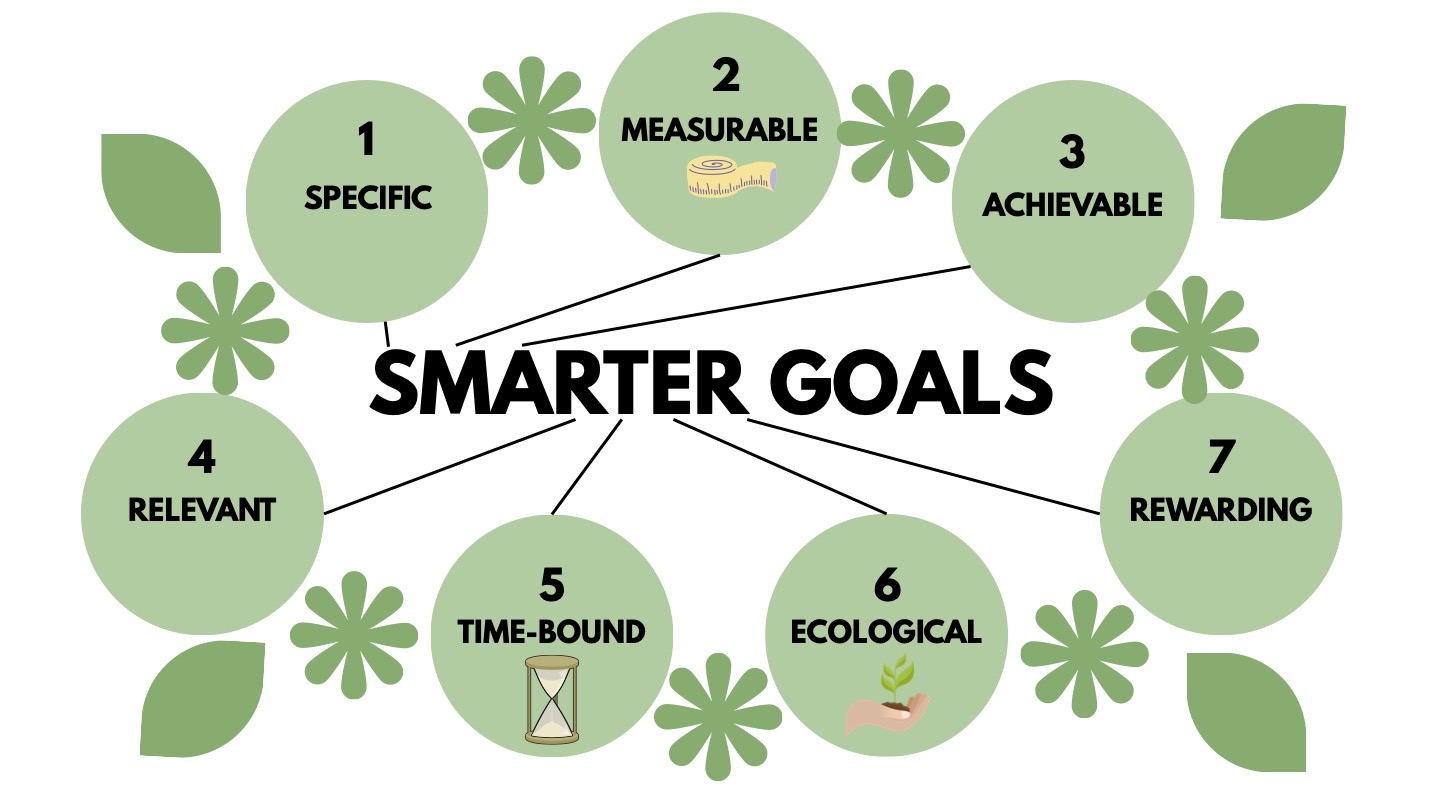
SMARTER Goals
Setting goals involves thinking about what we can and want to achieve. But many goals fall by the wayside – often within a matter of days or weeks. So how do we make sure that we continue on a route towards worthy goals? How can we prevent disappointments?
The key, in my opinion, is to make sure that all our goals are SMARTER:
- Specific – to time, to place and, of course, to you.
- Measurable – rooted in the real world, with clear metrics to define success.
- Achievable – realistically something we can do – not pipe dreams. Often using small and slow solutions.
- Relevant – connected, appropriate to people, land, time and place.
- Time-Bound – with a specific time-frame or deadline.
- Ecological – aligning with broader sustainability and environmental ethics.
- Rewarding – offering personal and wider benefits that incentivise and inspire.
An Example of SMARTER Goal Setting:
To give a clearer idea of what SMARTER goal setting looks like, take for example my own major goal for 2026 – writing a long-planned book on regenerative design.
This is of course a goal specific to me – something I have wanted to do for some time but have not quite managed to achieve so far. I am excited to begin on this project because I do feel I have a lot to share.
I can define progress towards this goal through the simple metric of word count, and obtain and integrate feedback along the way…
While, as an experienced writer, I could perhaps write more quickly, I have decided to break down the goal into more achievable chunks – writing sections each month between all my ongoing design work over the months to come.
I have now been working in permaculture design for a decade, and feel this year is a good time to try to gather together and synthesise much of what I have learned.
I am aiming to finish the book before the end of 2026, so will work on sections in milestones over the months to come.
The ideas in my regenerative landscape design focussed book will align with my other work within this field, and will, I hope, inspire and aid others to take a hopeful, regenerative path.
I will find the work rewarding in and of itself, but also believe that the project, once successfully completed, will bring many personal and broader benefits.
Of course, I have other goals too – in my garden, my personal life and my business – and as I have set these goals I have thought carefully about what the goals should be.
I’ve tried to move beyond generic (common) goals such as getting more exercise and eating more healthily, broad financial goals, garden goals, or spending more quality time with friends/ family, to create more tailored goals that can be achieved through specific and tailored plans.
A Permaculture Approach for Regenerative Design
Permaculture frameworks of design can help us to create goals that meet these criteria, and create plans to help us to achieve them. With a permaculture approach, all the goals that we set are rooted in the core ethics of care for our planet, care for humanity, and fair share.
But whether we are thinking about our gardens or land, or other areas of our lives, thinking a little more about setting SMARTER goals can be a great idea. This strategy for setting goals can be important element of regenerative design.
We can adopt principles of regenerative design not only when we are thinking about the best, holistic strategy for a piece of land. The principles can also be applied when we are considering design for our communities, businesses, households and personal and inter-personal lives.
So no matter which area we are looking at, and what type of goals we want to set in 2026, regenerative design can help. And regenerative design begins with smarter goal setting.
I can help with a regenerative design for a person, community, business, or piece of land. No matter your goals, please get in touch for a discussion and bespoke quotation. Share your goals and I can tell you how I can help you create a design to meet your goals for 2026.
 EWSP Consultancy