
As a garden designer, I have worked with clients to grow food in an amazing range of situations. Typical gardens are not the only option for food cultivation. There are so many other places where food can be grown – from polytunnels or greenhouses, to rooftops, balconies, or interior spaces in homes, restaurants, offices, business premises and more…
However, when growing food indoors or undercover, there are a number of special considerations different from the normal considerations for growing food outdoors. Unique spaces often require a unique approach when it comes to design and to the methodologies and strategies employed.
A recent polytunnel design project helps to show some of the methods and strategies that designers often employ to make the most of the space available and achieve good yields from unique undercover growing spaces:
Polytunnel Design Project
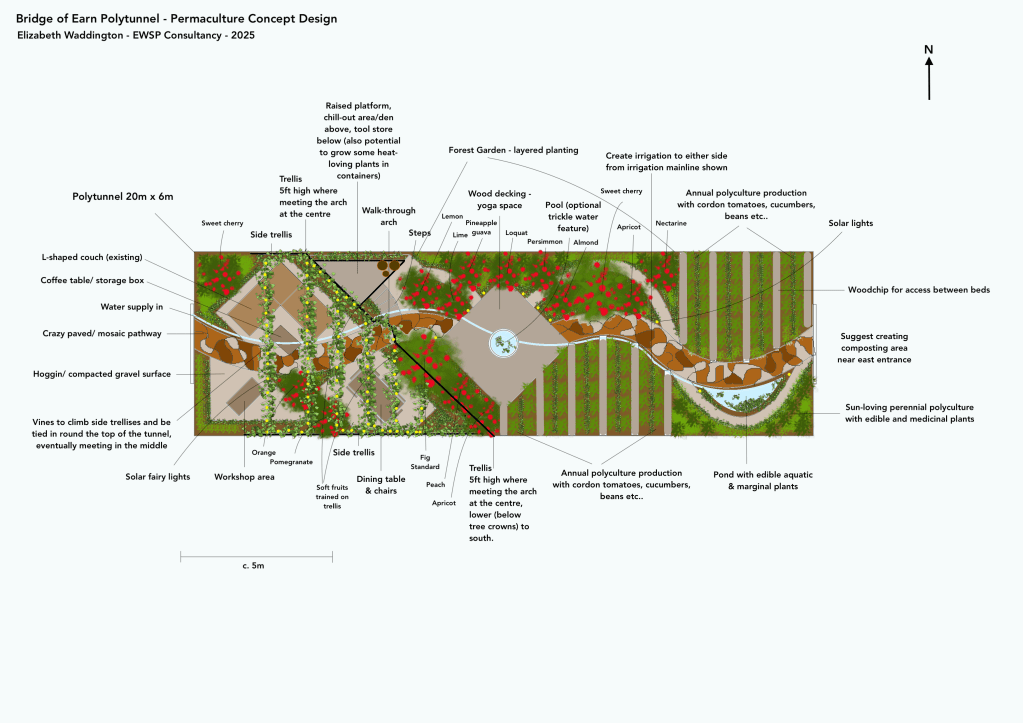
The first of these is a design for the interior of a 20m x 6m polytunnel located here in Scotland. The purpose of this project was to create a concept design with creative and quirky recreational space for a family with members of various different ages while also maximising food production.
The client wanted to grow plenty of tomatoes, cucumbers and other annual summer crops, while also experimenting with more unusual edibles not typically grown in the area, and with sustainable perennial methods of cultivation.
If you would like some assistance with a plan for your polytunnel, or wish to include a greenhouse or polytunnel in a larger design, please do reach out for a bespoke quote.
Growing Food in a Polytunnel – Key Design Tips and Recommendations
Designing well for undercover growing areas like polytunnels or greenhouses involves a clear understanding of the benefits they can provide as well as the challenges they can bring. Here are a few core things to consider:
As Always – Design for Your Location
In a greenhouse or polytunnel you and your plants will, of course, be insulated from the weather outside to a degree.
However, when you are designing for a covered space, you do still need to keep the local climate and microclimate in mind. Positioning such a structure correctly, and creating a plan suitable for the location, can be crucial to good results.
Use Restrictions and Challenges as Advantages
Restrictions and challenges within a polytunnel can, with a thoughtful approach, be turned into surprising advantages. Limited space, for instance, encourages careful planning and intercropping, fostering a more biodiverse and productive environment. Vertical growing, companion planting, and tiered systems flourish where square footage is at a premium, often yielding more per metre than sprawling outdoor beds.
Temperature fluctuations, while daunting, allow for creative solutions that improve overall resilience—like thermal mass, water barrels, or strategically placed compost bins. These not only moderate extremes but also turn potential weaknesses into strengths by feeding both plants and microclimates.
Pest issues, often magnified in enclosed environments, encourage a deeper embrace of ecological methods—introducing predatory insects, using fine mesh, or maintaining healthy soil as a first line of defence.
Even ventilation problems spur better airflow design and a heightened awareness of plant needs.
With an adaptive, permaculture mindset, each challenge becomes a cue to observe more closely, intervene less harshly, and design in a more harmonious way.
Think Outside the Box
Many polytunnels and greenhouses look almost identical inside – with growing areas or raised beds, with (depending on the width of the space) one or two straight pathways between them.
Often, these polytunnels or greenhouses are used to grow common annual or biennial fruits and vegetables in neat rows.
But thinking outside the box can yield some amazing results – allowing you to make creative use of all the space available, grow interesting plants that you might not otherwise be able to grow where you live, extend the growing season and increase yields.
Creating more flowing designs, with natural curves for example, growing vertically and making full use of the full height of the space, and embracing perennials rather than just annual crops are some ways to expand your polytunnel or greenhouse growing horizons.
Indoors Food Cultivation – Vertical Hydroponic Garden

This is sketch provided as part of consultancy of another recent 2025 design project – a small vertical garden in a restaurant in Sapporo, Japan. After an initial discussion about crops and potential methods, the client decided to opt for a relatively simple approach – the low-cost hydroponic system shown above, which will provide an abundance of leafy greens for the restaurant business.
An organic nutrient solutions will be used in the short term, with the potential to transition to a full closed-loop aquaponics system in future.
The idea is that this is a small test area before food production on the site can be scaled up somewhat in future.
Growing Food Indoors
Growing indoors can be more challenging than growing undercover – the main restrictions are typically low light levels and limited space. There may also be issues with watering, nutrients, pollination and/or pests to consider that do not usually come up for outdoors growers.
Here are some of the most important things to think about when growing food indoors:
Maximise Natural Light: Place plants near south-facing windows if possible. Use mirrors or reflective surfaces to bounce light around darker spaces.
Supplement with Grow Lights: In low-light conditions, use full-spectrum LED grow lights to ensure plants receive adequate light for photosynthesis.
Choose the Right Crops: Leafy greens (like lettuce, spinach, and rocket), and herbs (such as parsley and coriander) can be more tolerant of the lower light levels indoors and so can be a good place to begin if you are new with growing indoors. Growing micro-greens can be as easy as can be and hardly takes up any space at all.
Control Temperature and Humidity: Keep indoor conditions stable—most edibles grown indoors prefer temperatures to remain between 18–24°C. The ideal humidity range for most edible crops grown indoors is typically between 50% and 70%.

Again, Think Outside the Box: Try Hydroponics or Aquaponics: Soil-free systems like hydroponics (growing in nutrient-rich water) or aquaponics (combining fish and plant production) are efficient, space-saving, and ideal for indoor food growing. A closed-loop aquaponics system can be one of the most sustainable options for indoors cultivation.
Of course, many guidelines for design and plant care do carry over, wherever you place your garden. The key thing, as always, is to design for a particular space. If you require consultancy on anything raised in this article, I’d love to hear from you! Don’t let a lack of space or other challenges stop you from growing your own food!
 EWSP Consultancy