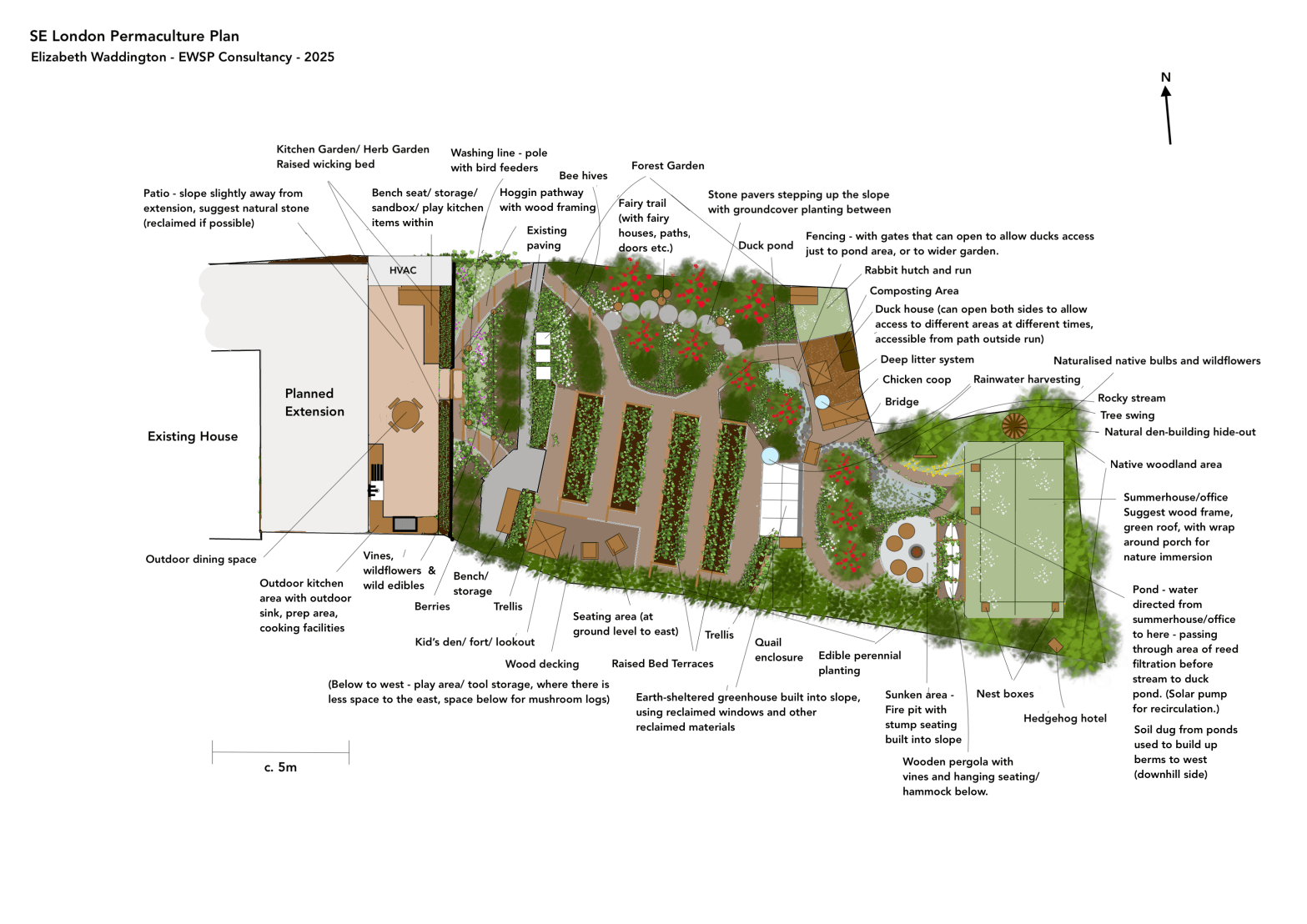

This design aims to make the most of this sloping site in South East London, while creating a biodiverse, ecologically complex, beautiful and productive family space.
The design aims to incorporate plenty of wildlife-friendly and child-friendly features while also ensuring effective and efficient water management and diverse food production for a resilient and sustainable way of life.
Natural Stone Patio, Wicking Beds
From the back of the planned extension, a natural stone patio extends the living space of the home, providing a seating and kids’ play area, dining area, and outdoors kitchen and prep zone. It should slope very slightly away from the home.
From here, the growing areas and recreational spaces extend up the hillside to the east. This planting plan was sent to the client along with a full plant list.

(Level changes in the design are very rough approximations (as building work is not done) but aim to elucidate the proposals made.)
Edging the patio, and doubling as a retaining structure are two raised beds, serving as a space for herbs, annual flowers and salad crops within convenient reach of the home. I suggest using railway sleepers, logs or other reclaimed/natural wood for the bed edges. (Wood used outside can be protected with Organowood or other eco-friendly products.)
I suggested creating wicking beds which can catch patio runoff and store water within reservoirs at their bases, which reaches plant roots from below and can be taken up as needed.
Vines, Lines and Wildflowers
Steps lead up between these two beds to the next ‘garden room’, where there is a drying line for laundry suspended above trellis with grape vines, and berry bushes, surrounded by a meadow mix of native grasses and wildflowers.
Hoggin pathways with wood framing gradually ascend through this area with a series of steps to reach the existing paved area above. This paving gives access to bee hives, in a further wildflower meadow area and a bench seat below a trellis forming the side of a wood deck above.
Raised Bed Terraces, Decking & Greenhouse
From the paved area by the bench seat, you can step up to the first annual production raised bed terrace. Three further raised bed terraces lead up the hillside from here, providing 8 modest bed sections for annual polycultures and 2 further sections for perennials (asparagus, strawberries and chives).
I suggested creating wood bed edging using natural or reclaimed materials, and filling beds using the lasagna bed method.
The wood decking is designed to create a level seating and play area, with a larger space underneath it on the side closest to the home, and a smaller space below the uphill side, where the deck is just above ground level. The deck is a ‘roof’ from the lowest terrace and just above ground level at the 3rd terrace.
I have suggested creating a kids’ lookout or fort on the decking in future, alongside a seating area. Below the decking, I have suggested creating a tool store and perhaps another play area, and an area for mushroom logs to grow oyster and shiitake mushrooms.
Above the terraces is a greenhouse, earth-sheltered, built into the west-facing slope. Here, more tender crops can be grown, and plenty of propagation can take place. A trellis clad with climbers and vines marks the upper extent of this section, next to the greenhouse.
Forest Garden, Fairy Steps
North of the terraces is a forest garden area, which can be explored via a series of stone steps leading up the hill between espaliered trees on the northern fence line and further dwarf trees and shrubs. Along this ‘secret’ stairway are a series of child-friendly features – such as fairy houses and pathways, little doors in trees, and little secrets hidden amid the planting.
On the southern fringes of the food forest area are useful pollinator attracting and otherwise useful plants also good for cutting for the home. A path skirting round the southern side of the food forest allows the steps to be avoided.
Livestock Areas
Reach the top of the steps or the pathway and to the south is a small duck pond within a fenced area. Gates in this fence can be opened and can cross the pathway, creating the option to release ducks from the duck house to the pond without allowing them access to the rest of the garden.
They can also be opened fully to allow ducks wider access, or fully closed to allow unimpeded walking access to the nesting boxes on the chicken coop, and to the uppermost part of the garden.
In the north eastern corner of the property, there is a rabbit hutch and run, adjacent to a duck and chicken run with a deep litter system, in which a garden composting area is also located. (I also recommended vermicomposting kitchen scraps in the outdoor kitchen by the back door of the home.)
In this livestock area, rainwater harvesting can help to meet the animals’ water needs, in addition to the nearby ponds and stream system.
Many plants from the surrounding planting can form a part of the diet of the animals reared in this area, and occasional access to other spaces may be granted to the ducks and chickens (when regulations allow).
Above the Greenhouse: Fire Pit, Garden Building & Native Trees
A bridge (I recommend making this of reclaimed wood) just south of this area crosses a rocky stream that links the duck pond with a slightly larger pond/ wetland system to the east.
A path leads south above the greenhouse, giving access to a further forest garden area and a space that can potentially be used for a quail enclosure in future, before curving round to the east to reach a sunken seating area with fire pit, and a garden building beyond.
The garden building, to be used as a summer house and office, is designed to be a retreat amid native trees, nestled at the back, and top, of the garden. I have suggested creating a wood-frame structure with a vine-clad pergola out front, from which seating or a hammock to enjoy the fire pit can be hung, and a meadow type green roof, suited to the partially shaded location.
Water collected from this structure can be directed to the pond/ wetland and then on to the duck pond via the stream (gravity fed). As needed, water might be recirculated to the upper pond using a solar powered pump.
To the north of the pond, a play space might ultimately have a swing in a tree, an area for natural den-building to the north of the garden building, and pretty little glades filled with native bulbs. Shadier spots to the east of the garden building might be used to cultivate native mushroom species.
Several wildlife-friendly features around the garden building between the native trees will help to ensure that wildlife finds a home in this wilder and less managed part of the space.
 EWSP Consultancy