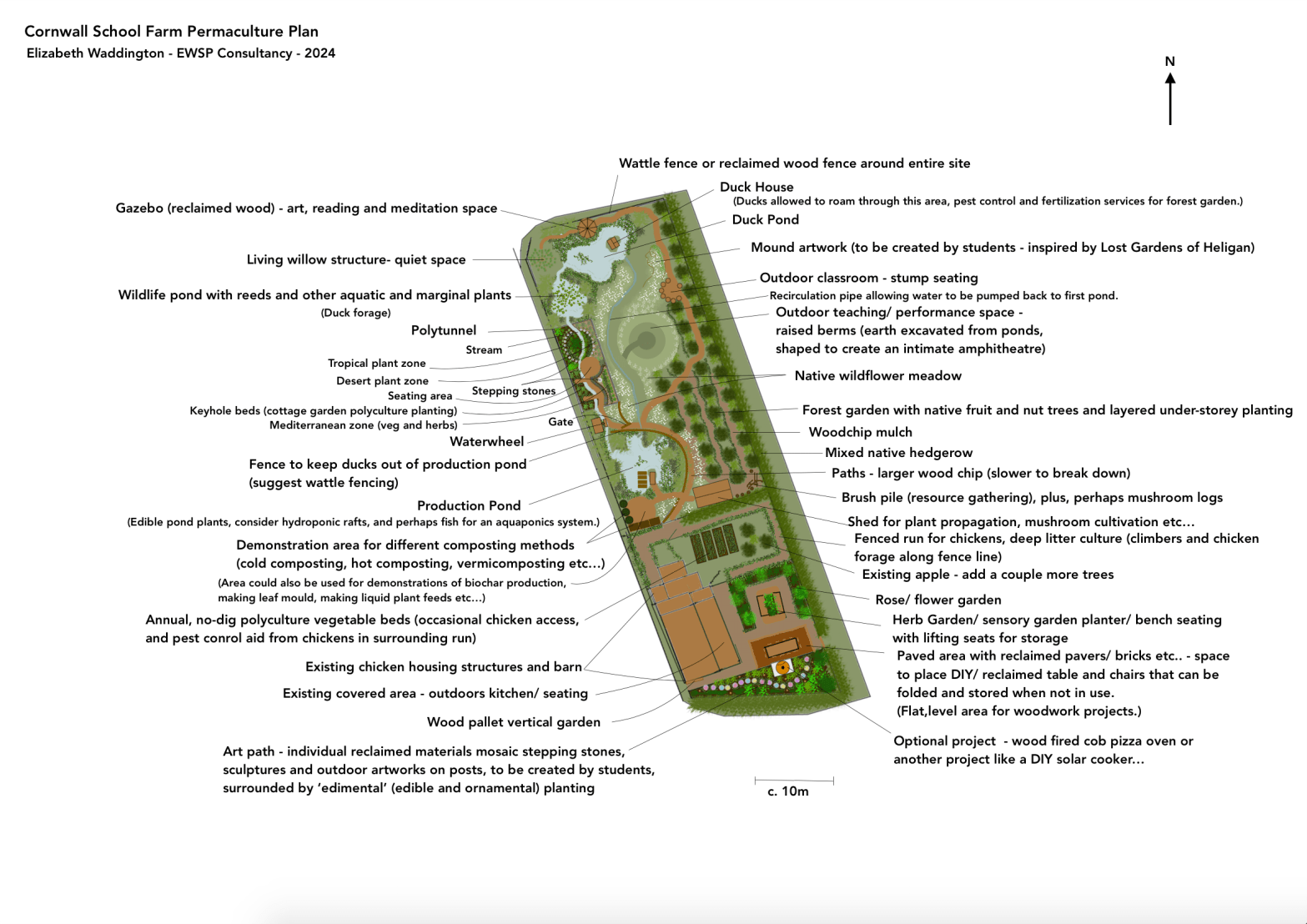

As well as working on designs for private properties, I also work on community projects. This is something that is very important to me, since I am very much aware of the criticisms of permaculture relating to its inaccessibility for many… and seek, where I can, to remove potential barriers.
Permaculture offers concepts and design methodologies that work, and we should aim to make sure even those who are traditionally underserved can benefit from them.
Last year, a youth worker in Cornwall reached out to me, and I was able to spend a little time putting together a design for his project. This project in South West England aims to build a farm like environment for both disaffected and neurodivergent young people.
Fowey, I am told, is one of the richest areas in Cornwall and so the school gets less funding as a result. However, its catchment includes Par and St Blazey, which are listed as some of the poorest and deprived areas in the whole of Europe. Some young people will only get a meal a day. The goal of this project is, in part, to draw in more funding and opportunities to provide for these young people.
This is quite an ambitious plan and will likely not be implemented quickly. Funding bids are still. I believe, outstanding. But the design aims to give a broad framework for them to work towards as they proceed.
The idea is that the young people will continue to be heavily involved in bringing the project to reality, learning some gardening, farming, woodworking and other practical skills as they do so. From digging the ponds to creating some fun outdoor artworks, this is a hands-on project that should help with skill-building and bring both pride and purpose to those involved.
Even once key projects on the site are completed, this should continue to be a space that gives back, enriching the lives of the young people and other members of the local community who are able to spend their time there.
I would love to hear from schools, youth workers, charities or community groups who are interested in a design for their own garden or farm project, so if you would like to discuss my design and consultancy services, please do get in touch.
In addition to providing the design above, I also provided some further details – quick sketches relating to the ponds, for example:


I also created a suggested implementation plan to guide the creation stage of the project:
Phase 1:
- Mark out and undertake earthworks for ponds, stream and pipework.
- Mark out and create small amphitheatre/ teaching and performance space.
- Plan and create base for mound artwork.
- Source bare root trees/shrubs if possible for hedges/ forest garden – plant these out.
- Begin to gather upright stakes and pliable branches for wattle fencing – create brush pile.
- Set up composting systems and make leaf mould from fallen leaves.
- Create wattle fencing if natural branches are available.
Phase 2:
- Mark out and begin to create wood chip pathways.
- Sow grass and wildflower seed on amphitheatre and around.
- Mow or scythe, scarify existing grass cover and sow native wildflowers in suggested meadow areas.
- Plant up/ sow mound artwork plants.
- Layer cardboard and wood chip mulch around trees planted in forest garden area and add stumps for outdoor classroom seating.
- Select nitrogen fixing plants and dynamic accumulators (e.g. comfrey) for chop and drop and add these to begin creating layers in the forest garden.
- Mark out, make no dig bed, and, if possible, start to sow/plant veg and herbs in the polytunnel.
Phase 3:
- Late spring/ early summer – Source aquatic plants and plant in and around ponds.
- Successional sow and tend polytunnel plants.
- Chop and drop in forest garden (and make liquid feeds e.g. comfrey feed) for polytunnel plants.
- Propagate plants to expand forest garden and create edimental planting around art path (request/ take cuttings, divisions etc…)
- Building projects – fencing, possibly shed and gazebo?
- Refine chicken fencing and create no dig vegetable beds.
- Create the Art path and outdoor artworks if there is time…
Phase 4:
- Early autumn – sow cover crops/ green manures into no dig vegetable beds.
- Sow crops to overwinter in the polytunnel.
- Undertake additional planting in forest garden.
- Put art path together and plant surrounding area with edimental planting.
- Source materials and create reclaimed paving area.
- Make wood pallet vertical garden.
- Create sensory garden planter and bench seating.
Phase 5:
- Prepare raised beds (with the aid of chickens).
- Sow crops and plant for polytunnel, raised veg beds, sensory herb garden and vertical garden.
- Make and add waterwheel to stream and potentially aquaponics systems to pond.
- Finish fencing the whole site if not already accomplished.
- Undertake additional projects such as gazebo, living willow structure, cob pizza oven/ solar cooker, and duck house if not already accomplished.
- Consider carefully introducing ducks to established systems.
- Assess and undertake maintenance on current areas.
The above is just a taste of some of what I can offer to help projects at the design and implementation phases.
I very much look forward to hearing how this project progresses and hope that it might inspire other similar projects in other locations, in the UK and elsewhere.
 EWSP Consultancy