Rewilding cities and other human-centric spaces is increasingly important, as more and more people spend their lives in massive metropolises with little access to truly natural and ‘wild’ environments, and as we encroach ever more on the wildlife around us.
Rewilding Cities: Identifying Sites for Permaculture Design

Identifying land suitable for rewilding in cities and towns can often be the first stumbling block for those who wish to improve the urban environments in which they live.
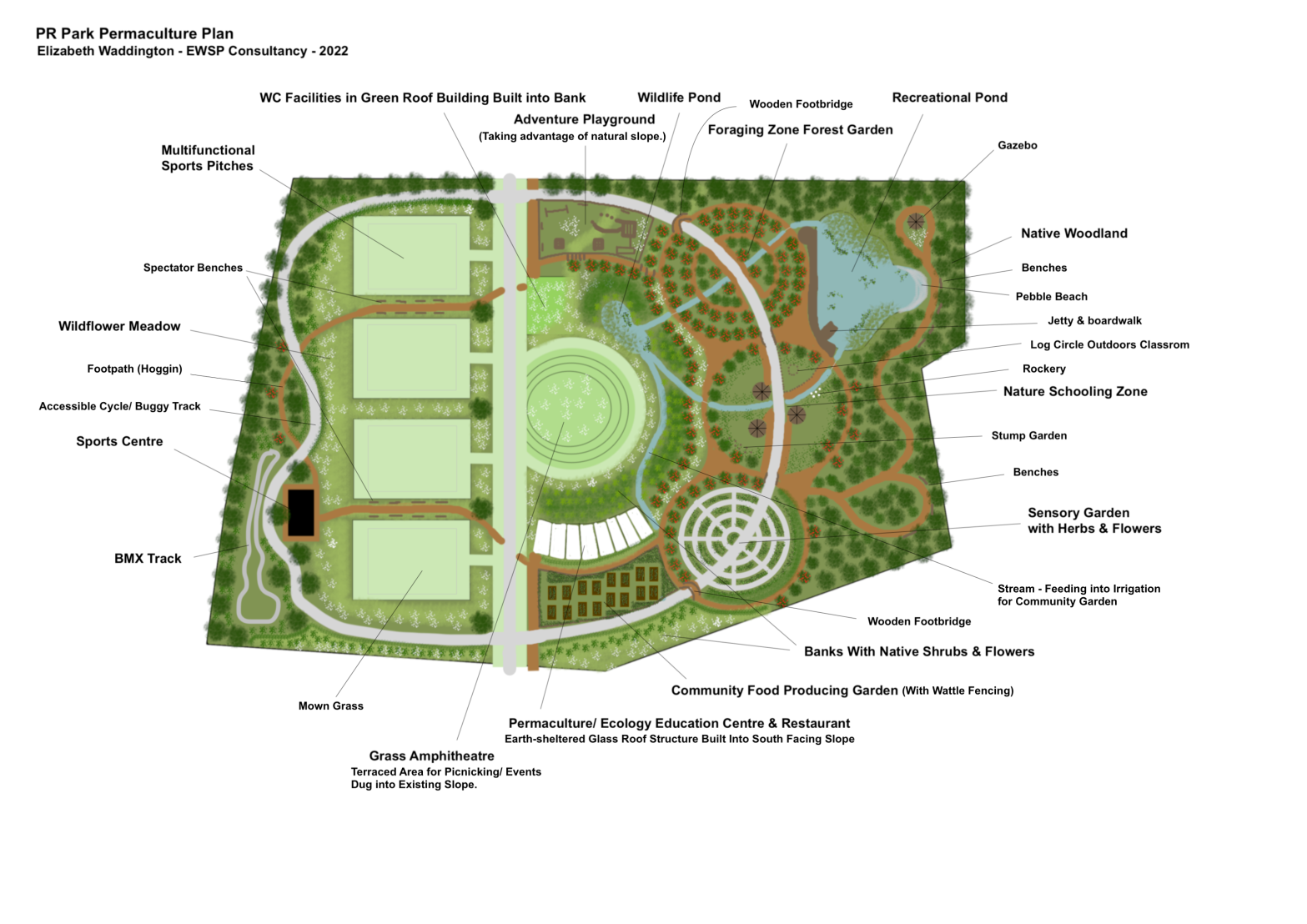
Sometimes, as in the example above, public land does become available and it is possible to work on a slightly larger scale in order to improve land and engage in some rewilding. At other times, finding land or gaining access over land can be a challenge.
When looking for land to adopt and improve (or simply land that can be allowed to regenerate on its own) we need to keep open minds and look at a wide range of possibilities.
Of course, local authorities such as regional governments and/or local councils bear much of the responsibility, since much of the land in their jurisdictions will be in their hands. But as communities and as individuals, there are opportunities to gain control over land for rewildling – not only through appeal to local authorities.
It can be useful to think about who, in your area, has access to land and control over how to use it. Approaching those in control of areas of land in your community, such as schools, churches or major land owners, can help you to find potential places where rewildling might be able to go ahead and forge new collaborative links.
It is important to consider brownfield sites, and small areas often overlooked when coming up with ideas about where to rewild and create new planting schemes to re-green the streets of our cities. Observing where we might need to break up concrete or asphalt to let native back in could often be key to turning our cities into the nature-forward spaces they can be.
Barriers to City Rewilding and Re-greening Initiatives
Even once land is identified where rewilding initiatives might be carried out, there are still other barriers that can get in the way of those initiatives. overcoming those barriers can take time, but it is important to think about what those barriers are how we might be able to overcome them.
Barriers that are often encountered are:
- Political barriers: such as a lack of political will to make the changes for the environment that we desire. Politicians are unlikely to act unless the political will is there – unless they think/know that we care, they will often fail to act unless pushed to do so. Through voting and activism we can make our voices heard and make it easier for politicians to justify rewilding and re-greening projects to colleagues.
- Economic barriers: with only so much money for local authorities, austerity and the policies it imposes have been a major barrier to sustainable change at community level. By taking land, and projects into their own hands, local communities can work to raise capital and help reduce economic short-sightedness, showing the value of nature and a triple bottom line method of accounting.
- Social barriers: social barriers can be either practical and/or associated with people’s perception or fixed ideas. An example of the former is when a piece of land needs to be used by a community in ways supposedly incompatible with rewilding (as sports fields, for example). An example of the latter is when verges or edges are perceived by the public to be ‘full of weeds’ and people complain to the authorities about it.
Blending the Environmental and Social – Planting With Purpose
In many respects, the social barriers to rewilding projects in cities and towns are perhaps the most complex, and the most difficult to overcome. Changing minds is more difficult than changing systems, and most of the time, changing minds has to come first.
One of the key ideas that we need to overcome is the idea that rewilding is only about the environmental, and that rewilding is the antithesis of using land for human benefit. Just because nature is allowed to thrive, that does not mean that people cannot thrive too – in fact, nature thriving leads to humans thriving.
Often, when discussing rewilding projects, people fall into a false dichotomy – thinking that we can use land for rewilding or other community use (recreation, food production etc..). Permaculture shows is that it does not need to be either/or, it can instead be rewilding and…
Permaculture design and planting with purpose is all about planting for nature and humanity – finding ways to increase social as well as environmental benefits in our planting schemes.
Rewilding can create jobs – as work in Scotland’s rewilding sites have shown. An analysis of 13 major rewilding projects covering almost 60,000 hectares between them has revealed a 412% increase in jobs since rewilding began, according to new research from Rewilding Britain.
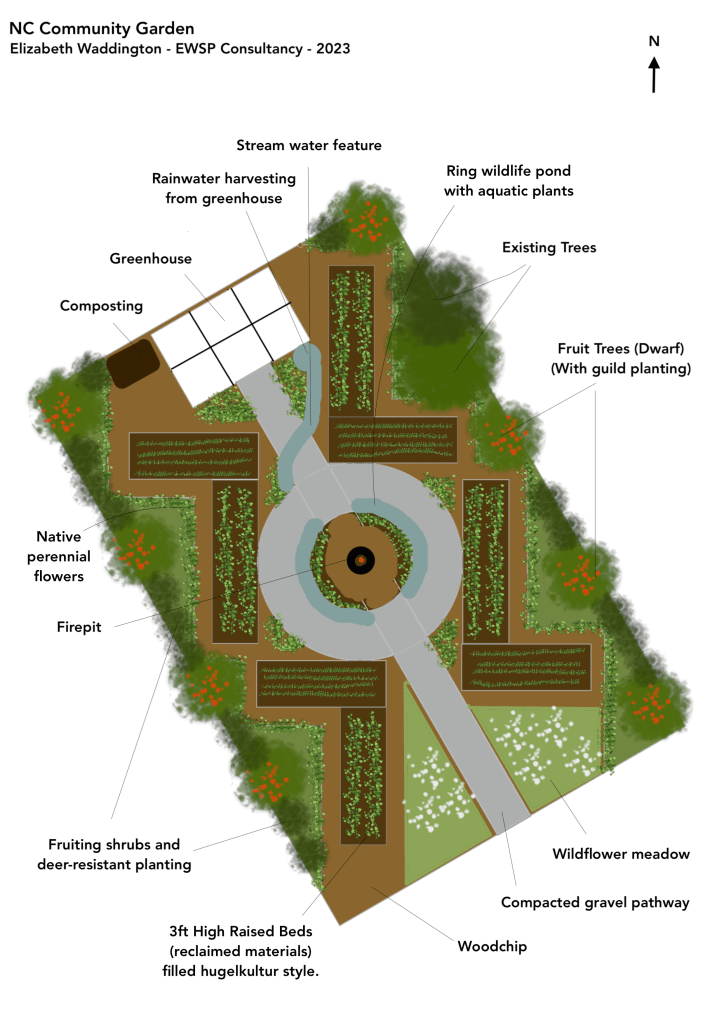
In cities, as well as rurally, rewilding can bring opportunities for job creation and community revitalisation. As parts of broader community parks, community gardens, or other community projects, or as stand-alone schemes such as community woodlands, meadows, ponds or wetlands… they can enrich the environment for people in addition to providing a haven for many other species.
Rewilding schemes can also provide food in food deserts, help to tackle social injustices by giving equitable access to the natural world, and provide a range of recreational and artistic spaces…
Planting with purpose in cities to achieve both environmental and social goals can help us to make wilder places more fit to serve a city’s needs. Careful and tailored planting plans can help make sure that nature is allowed to thrive and allow for regeneration to the point where nature can reign once more.
I am currently working on a small city rewilding project for a site in England and I will share the concept plan for this project next week. Increasingly, communities are recognising that helping nature is one of the best ways to help themselves, and that when politicians and others fail them, they need to take matters into their own hands.
 EWSP Consultancy