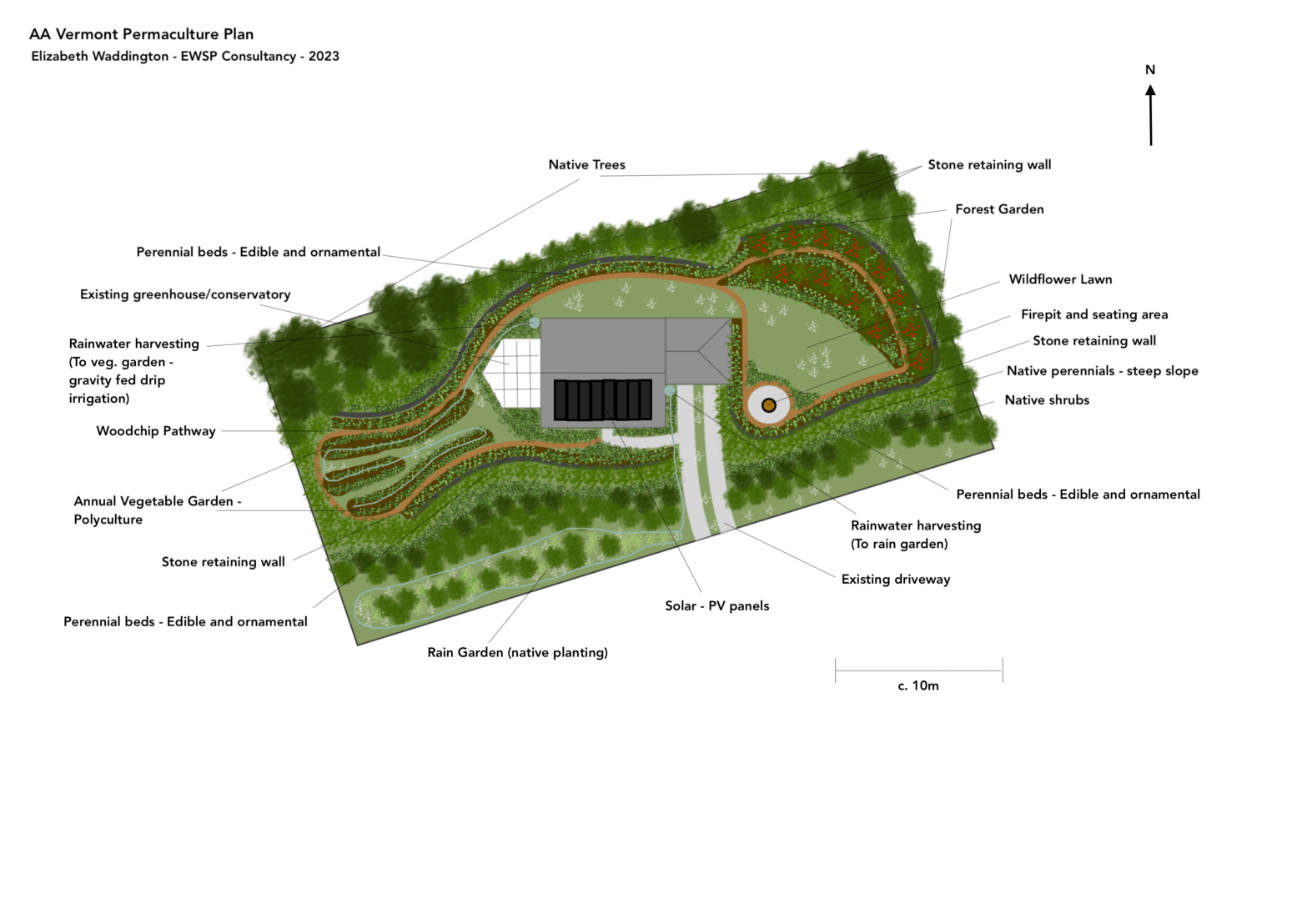

This case study shows my design for a steeply sloping site in rural Vermont, completed late last year. The design was created for a husband who wished to surprise his wife with a design for their new property as a Christmas gift.
The couple fell in love with the rural property, with its great views looking out over a wooded valley and forest backdrop. But they were struggling to see how to create the food-producing garden that they desired on this tricky site and worried about the stability of the steeply sloping terrain as Vermont’s climate continues to get warmer and wetter as our climate crisis continues.
Dealing With a Sloping Site
The site broadly speaking slopes steeply downwards from north to south with a change in elevation of around 10m from the highest point to the north east to the lowest point in the south west, with a number of shifts in gradient across the site.
I have suggested the extension and slight modification of an existing stone retaining wall, and the addition of further stone retaining walls to create and define some key garden areas, of gently sloping terrace, which make for a more usable space.
Terraced areas with a reduced gradient will be used for key growing areas – annual vegetable beds and a forest garden – as well as perennial ‘edimental’ planting and recreational space, while steeper slopes will be stabilized with appropriate planting as well as stone retaining walls.
Managing Water Effectively
Water management strategies employed will include gravity-fed drip irrigation for annual beds and the direction of rainwater from the front of the home which was risking washing away parts of the existing driveway, to a rain garden at the lowest point on the property.
If you are interested in creating a future-proof design for your property, which helps you to understand how to deal with slope, and/or manage water effectively, please do get in touch.
 EWSP Consultancy