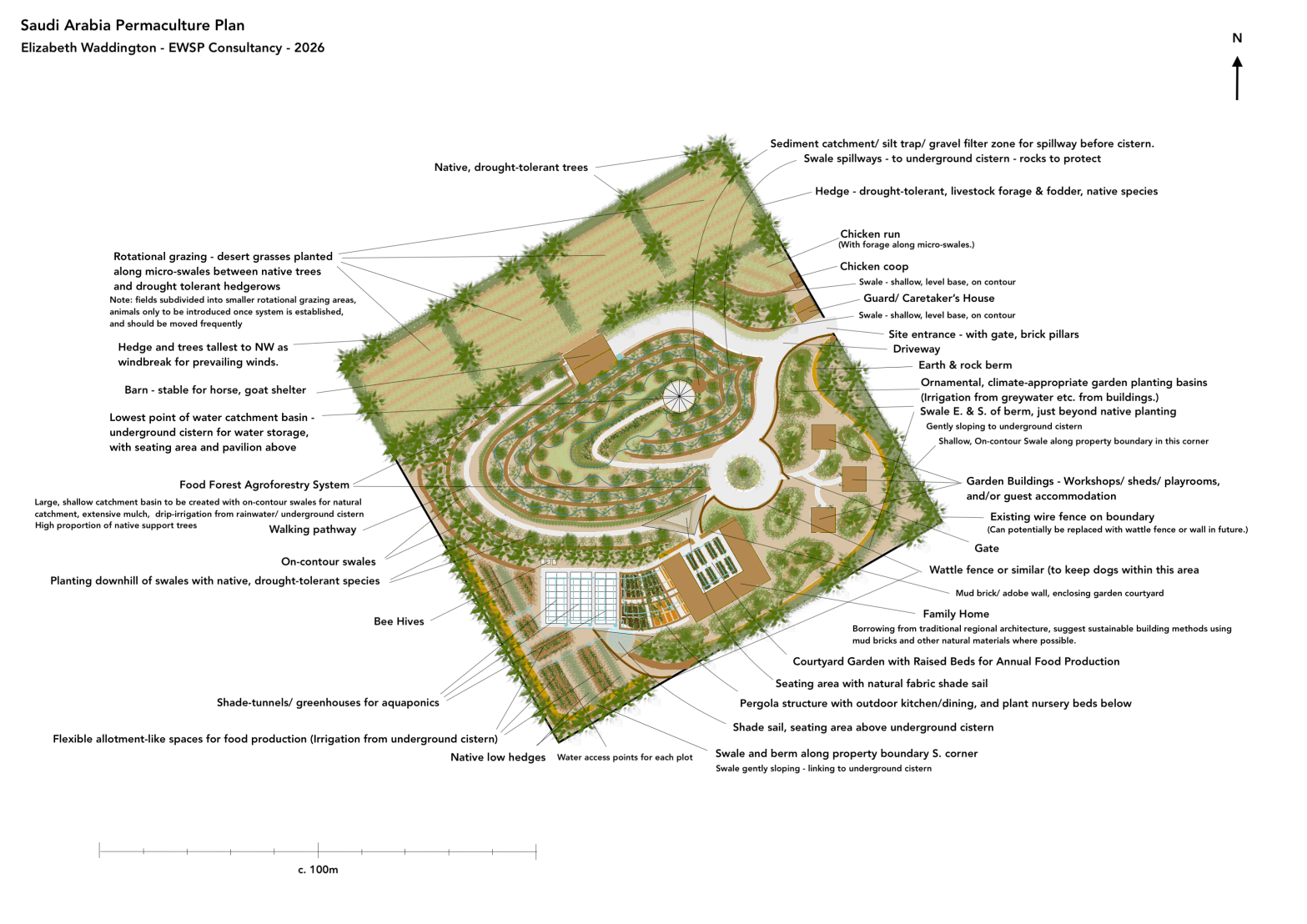
This permaculture design proposes a resilient, climate-appropriate land system for this 1-hectare desert site in central Saudi Arabia. The plan integrates water harvesting earthworks, windbreak establishment, drought-tolerant native tree systems, rotational grazing paddocks, and intensive food production areas supported by stored rainwater (underground cisterns) and greywater reuse.
The design is specifically adapted to the harsh desert realities of the Najd region: low rainfall, extreme summer heat, high evaporation, wind-driven sand movement, and occasional high-intensity storm events. The plan prioritises long-term survivability and low ongoing inputs, with the intention of improving soil function and biomass year by year.
The design aims to:
- Harvest and store water safely and efficiently
- Reduce wind stress and create sheltered microclimates
- Regenerate soil function using vegetation, mulch, and managed grazing
- Establish drought-tolerant perennial systems with low irrigation dependency
- Provide intensive food production zones near the home
- Integrate animals (chickens, horses/goats) without causing degradation
- Create a functional, comfortable living landscape for year-round use
The Site:
This 100m x 100m site in central Saudi Arabia is defined by an arid desert climate with extreme summer temperatures, low and irregular rainfall, high evaporation, and frequent drying winds.
The most limiting factor for plant growth is not only the lack of rain, but the combination of intense solar radiation and persistent airflow that rapidly removes moisture from soil and leaves. Rainfall typically arrives in short, intense storm events rather than gentle seasonal soaking, meaning that much of the water can be lost as fast surface runoff unless the landscape is shaped to slow, spread, and infiltrate it.
Soils in this region are often sandy or sandy-loam with low organic matter, which reduces water-holding capacity and makes young plantings vulnerable without mulch, protection, and careful establishment.
Microclimate creation is therefore central to the success of this project.
The prevailing NW winds can cause dust and sand movement that damages foliage, buries seedlings, and increases irrigation demand. Establishing windbreak trees and hedgerows on the windward boundaries reduces wind speed across the site, creating calmer zones where gardens and trees can thrive.
Shade is equally critical: pergolas, shade tunnels, and eventually tree canopy cover reduce ground temperatures and slow evaporation.
Over time, the food forest catchment basin and swale system will help concentrate moisture and organic matter, forming a cooler, more humid “oasis effect” that supports greater plant diversity. In this environment, phased planting and early focus on hardy native support species are essential for building long-term resilience.
Zone 1:
Zone 1 contains the most frequently visited and highest-maintenance areas of the site, including the home, daily-use gardens, nursery systems, and intensive growing spaces. These features are clustered for efficiency of labour, irrigation, and protection from heat and wind.
Guard/ Caretaker’s House
The caretaker’s house is positioned near the entrance to support daily site management, security, and rapid response to maintenance needs such as irrigation checks, animal care, and stormwater inspection.
Its location allows oversight of access points while also supporting the management of nearby systems such as the chicken area and boundary planting. In desert environments, having someone close to key systems greatly increases survival rates for young plantings and reduces the risk of infrastructure failure during storms or extreme heat events.
Family Home
The family home forms the social and operational centre of the site. It is positioned within the most sheltered part of the plan, benefiting from nearby plantings and earthworks that reduce wind exposure and create a calmer microclimate.
The home zone is designed to connect directly with food production areas, shaded outdoor living spaces, and the courtyard garden, ensuring that the highest-value systems receive the most attention and care. Building methods are suggested to draw from regional architecture, including thermal mass materials such as mud brick or adobe-style walls, which can significantly improve indoor comfort in extreme climates.
Courtyard Garden
The courtyard garden with raised beds is the key annual food production space. Raised beds allow better control of soil structure and fertility, which is critical in sandy or low-organic desert soils.
This area is designed for high productivity and frequent harvest, supporting vegetables, herbs, and small fruiting plants.
Shade structures, trellis, wind buffering, and careful irrigation management make this zone reliable and efficient. The courtyard format also supports privacy, reduced wind stress, and better water use efficiency, creating a protected growing environment within the broader desert landscape.
Guest Accommodation & Dog-friendly Garden Area
Guest accommodation and associated garden space provide flexibility for visitors and additional site use – perhaps as workshops, sheds or playroom spaces, for example.
This zone is also a dog-friendly enclosed area. The design suggests a wattle fence or similar enclosure to keep dogs contained without requiring permanent heavy infrastructure. This area can also function as a transitional landscape—more ornamental and low-maintenance—while still contributing to cooling, shade, and biodiversity through climate-appropriate plantings.
Pergola Plant Nursery & Outdoor Living Space
The pergola zone functions as both an outdoor living area and a plant nursery space. In desert climates, a nursery is essential because direct planting into harsh sun and wind often results in high losses.
By raising and hardening plants under shade, survival rates increase dramatically. This space supports seedling propagation, pot-grown trees, and the gradual expansion of the site’s planting systems.
The pergola also provides a comfortable outdoor kitchen/dining and seating area, designed for use during cooler mornings and evenings. It connects human comfort directly with land stewardship, encouraging daily observation and interaction with the landscape.
Shade Tunnels/ Greenhouses for Aquaponics
Shade tunnels or protected structures are proposed for aquaponics and climate-controlled growing. In Saudi conditions, fully sealed greenhouses can overheat rapidly, so shade tunnels with strong ventilation are often more appropriate.
These structures support year-round production of greens and seedlings, while aquaponics can provide efficient water cycling and nutrient supply. This zone should be designed with heat management in mind, including shade cloth, airflow, and secure water storage to prevent rapid warming.
Located near the home, it allows frequent monitoring, which is essential for aquaponic stability.
Allotment-Like Growing Areas
Flexible allotment-style growing plots are included for seasonal food production and experimentation. These spaces allow the household, or friends and family, to expand annual cropping when conditions and water availability permit, while remaining adaptable in drier years. Irrigation is supplied from the underground cistern when conditions allow.
Zone 2:
Zone 2 supports semi-managed systems that require regular attention but not daily intensive labour. It includes perennial food production, pollinator support, and small livestock systems that contribute fertility and ecological function.
Chickens
The chicken system is positioned close to the caretaker’s house for daily care and ease of management. Chickens provide manure, pest control, and soil disturbance when used appropriately. In this climate, heat stress is the main risk, so the coop and run require deep shade, excellent ventilation, and reliable cool water.
The design includes micro-swales and forage planting within the chicken run, supporting a more self-sufficient system. Chickens can also be rotated into different garden areas (carefully and seasonally) to clean up pests and fertilise growing areas.
Bee Hives
Bee hives are placed in a calmer area with good access to flowering plants and water. Bees play an important role in improving pollination for the food forest, aquaponics areas, and annual gardens, increasing yields and ecosystem resilience.
In desert conditions, hive placement must consider shade and protection from direct sun and wind, as overheating can stress colonies. Locating hives near diverse native plantings and productive areas supports both honey production and broader biodiversity.
Food Forest Water Catchment Basin
The food forest is built around a central water catchment basin and on-contour swales. This is the heart of the site’s long-term productivity strategy, designed to create a self-supporting tree system over time.
The basin is intended to slow and spread rainfall runoff, allowing water to soak into the soil profile and support deep-rooted trees. Initial earthworks will aid long-term success. I recommend excavating to create a gentle basin, around 0.4-0.6m deep at the base, with swales on contour around the sides as shown on the concept plan, and trees planted in berms.
Recommendation is that the swales should be approximately 30cm deep, and c. 1m wide at the top, with very gentle side slopes and low and wide berms on the downhill sides. (Trees planted into berms.)
The design includes spillways with rock protection and a sediment trap/gravel filter zone before water enters the underground cistern. Spillway width: 0.8–1.5 m, Armour: rock (angular stone.This is vital in Saudi storm conditions, where sediment loads can be heavy.
Mulching, layered planting, and a high proportion of native support trees are essential here. The food forest should be established gradually, beginning with hardy pioneers then introducing productive species as soil moisture and microclimate improve.
Zone 3:
Zone 3 contains the largest-scale systems: grazing, windbreaks, and boundary earthworks. These areas are managed less frequently but have major impact on overall site resilience.
Barn & Rotational Grazing
The barn (exact sizing and stock levels tbd) supports horse and goats and connects to rotational grazing paddocks. Rotational grazing is essential in desert settings to prevent overgrazing and soil exposure.
The plan includes micro-swales and planted grasses between rows of trees and hedges to encourage groundcover establishment.
Livestock should only be introduced once plantings are well established, and animals should be moved frequently to allow long recovery periods. This zone is designed to restore soil function, increase organic matter, and stabilise the landscape over time.
Windbreak Trees and Hedgerows
Windbreaks are concentrated toward the NW boundary to reduce the force of prevailing winds. This is a critical desert survival strategy: reducing wind lowers evaporation, protects young trees, and reduces sand blasting. Hedgerows also provide habitat, potential fodder, and additional biodiversity.
Windbreaks should be designed as multi-row, semi-porous plantings rather than a solid wall, ensuring airflow is slowed without creating destructive turbulence.
S/ SE Swales and Berms, Native Planting
Swales and berms along the southern and south-eastern boundaries provide additional water harvesting and edge planting. Native drought-tolerant species planted downhill of swales benefit from infiltrated moisture and improved soil conditions.
Swales 0.5 m deep x 2.5–3.0 m wide on contour
Berm 0.6–0.7 m high, ~3 m base width
spillways 2.0 m wide, rock-armoured every 30 m
These earthworks create a resilient framework for long-term planting success and controlled stormwater movement.
Suggested Implementation Plan:
Phase 1:
Phase 1 focuses on earthworks: creating the central catchment basin, constructing on-contour swales, building armoured spillways, and installing the sediment trap and underground cistern system.
Phase 2:
Phase 2 establishes the windbreaks and native hedgerows first, as these provide immediate protection and improve survival for all later plantings. Primary buildings and the driveway and core pathway can be constructed during this stage.
Phase 3:
Phase 3 introduces nursery-grown trees into the food forest basin and swale berms, supported by mulch and targeted irrigation.
Phase 4:
Only once vegetation cover is stable should grazing be introduced, starting with small paddocks and strict rotation.
Phase 5:
Finally, the intensive Zone 1 systems—raised beds, shade tunnels, aquaponics, and allotment plots—are expanded gradually as water storage and site microclimate improve, ensuring the project remains productive, resilient, and manageable long-term.
With appropriate surveying, careful construction of earthworks, and phased planting/animal integration, the site has strong potential to evolve from exposed desert conditions into a sheltered, biologically active, productive landscape.
Planning a project in an arid or challenging climate? I work with a small number of clients at a time to ensure each project receives careful attention. I am currently booking new design projects for April–May. I help clients develop resilient, site-specific landscape systems that work with nature rather than against it. Contact me to discuss your land and design goals and to receive a design proposal and bespoke quotation.
 EWSP Consultancy