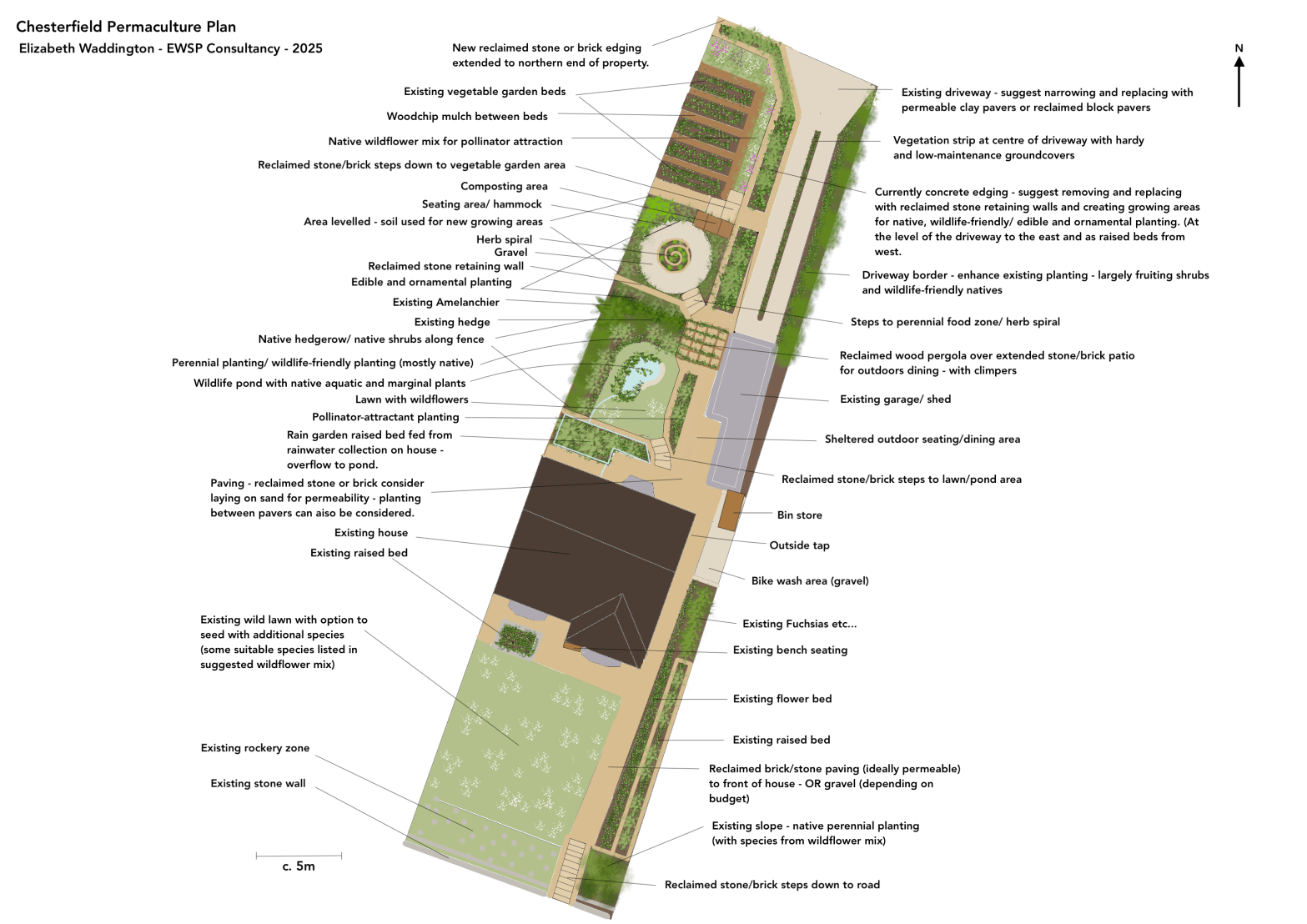

This plan shows my proposal for a redesign of the garden, in Chesterfield, Derbyshire, England. Though the current garden is productive, with plenty of annual crops and some other plants growing successfully at present, the goals included developing a plan for the replacement of degraded concrete paths and driveway, and increasing permanent perennial planting for a more wildlife-friendly and cohesively sustainable space.
The Back (North) Garden
The back garden is the main focus area for the design. My planting plan for this area is designed to provide a holistic plan – though existing plants that are thriving and desirable can be retained within the broader suggested framework of this design.
Immediately to the north of the existing house, I propose replacing the existing concrete with a new patio of reclaimed stone/ brick.
A raised bed rain garden at the patio edge will help to manage and help to infiltrate rainwater falling on the roof. Excess water from here can then be fed to the suggested wildlife pond via a French drain system or similar.
Around the wildlife pond, within the lower lawn area, is a sheltered area protected by fencing/ hedgerows, where edimental planting with a high proportion of native plants will help to bring in plenty of wildlife while also creating an attractive and restful space. (I mentioned to the client that existing annuals and bedding plants can also be integrated within suggested perennial/ biennial planting if desired.)
Continuing to the north, a reclaimed wood pergola is suggested, as a frame for climbing plants, and as a space to sit out or dine outdoors on nice days. This will also help to define the different ‘rooms of the garden’ – in the space between the existing hedge and the garage.
Beyond the pergola, steps lead down to a levelled area, with a retaining wall created to create a raised bed behind the existing hedge. A gravel circle with a herb spiral at the centre here provides space for a hammock or seating, while planting around the edge provides food, resources for organic gardening, and wildlife attraction.
I have suggested replacing the existing driveway with a narrower driveway made from permeable clay pavers or reclaimed block pavers, and replacing crumbling concrete along the west side of the existing drive with a raised bed that slopes down with the driveway – forming a raised bed for two lower areas on the west side. (There is also space here to continue to dry clothes on a line outdoors.) I have also suggested a vegetation strip down the centre of the driveway.
To the east of the driveway, adjacent the short retaining wall that separates this property from the neighbour, I suggested creating a row of cordon fruit bushes/ canes, with some low-maintenance perennial planting in front.
To the north west of the property, existing vegetable beds will be retained, surrounded by mulch, and a suggested wildflower meadow area. This area is lower, and accessed by steps from the driveway, which I suggest are constructed from reclaimed stone or brick. It is delimited by the raised bed passing downhill to the north along the edge of the driveway, containing edible/useful and wildlife-attractant plants.
The Front (South) Garden
In the front garden, existing planting will be largely retained as they are currently, with potentially just a few additional native wildflowers. (To be taken from the lists given below.)
The current pathways to be replaced with reclaimed stone/brick paving, or gravel, depending on budget.
I also provided a full planting plan and plant list for this property.
If you are interested in making improvements to your own garden, please get in touch to discuss a design or flexible hourly consultancy for your project.
 EWSP Consultancy