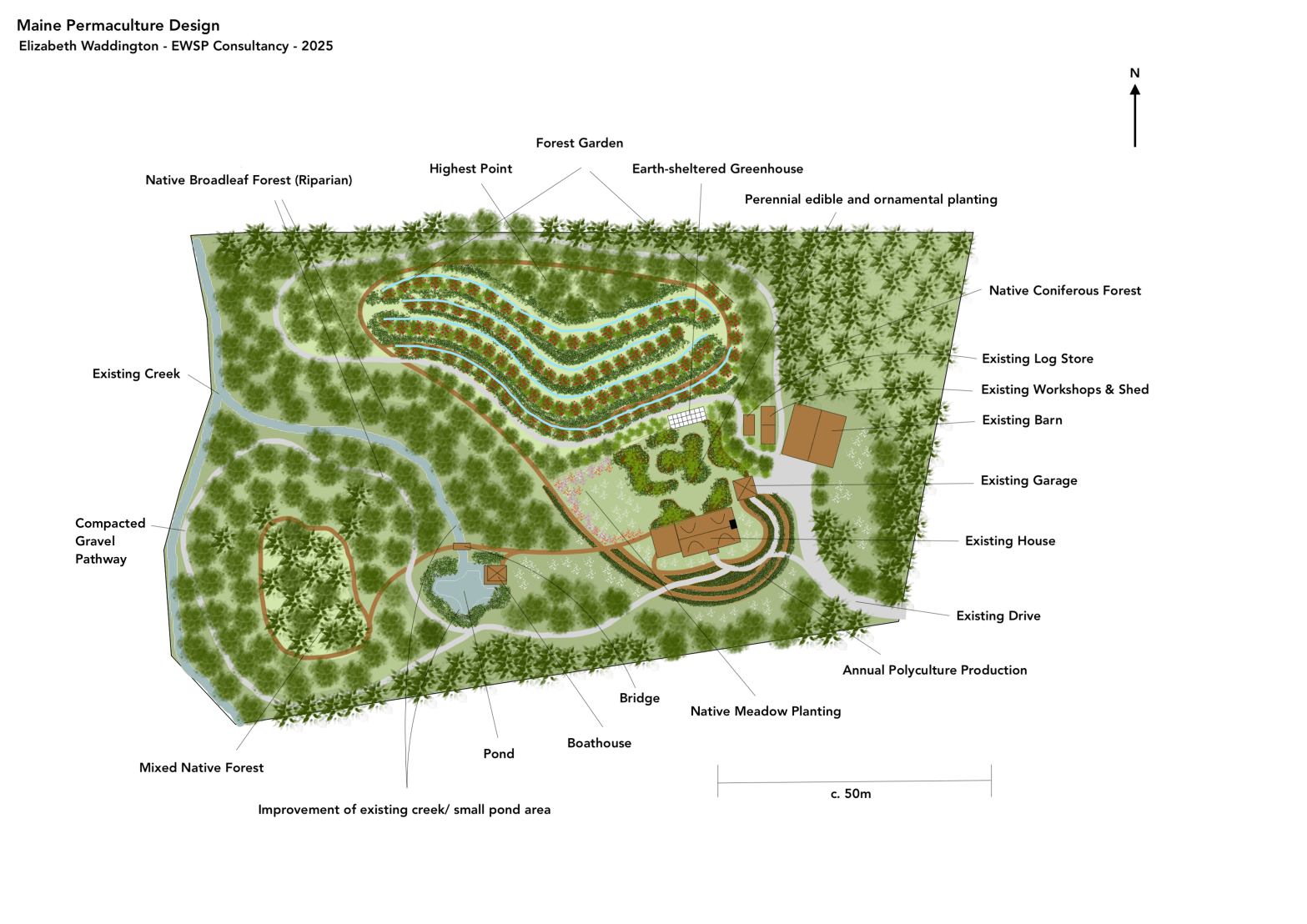

This is my design for a property of approximately 2 – 2.5 acres in Maine, USDA zone 5a. Like many of my designs, the starting point for this project was the desire of the property owners to increase the amount of food that they grow for themselves and their neighbours. They were also excited to learn how they could also restore somewhat degraded farm and forestry land to improve the ecological health of the site.
If you have similar goals for your own property, wherever you live and however challenging the conditions may be, I’d love to hear from you. Please do contact me to discuss how I can help through either consultancy or design.
Sustainable Food Production
Creating this design, of course, involved an understanding of Maine’s climate as well as the micro-climate on this specific site. Cold winters, moderately warm summers, and a relatively short growing season (about 120-150 frost-free days) can mean some challenges for gardeners. However, the climate and conditions still allow for the production of plenty of food and the growth of plenty of other resources.
Plants were also carefully chosen throughout to work in the loamy but rather nutrient-poor, somewhat acidic soil on the site.
Elements of this design such as perennial food production using climate-appropriate species in a layered forest garden, and taking advantage of south-facing slope in a relatively sheltered position for polyculture annual production are among the strategies that might be of interest to other cooler-climate, northern gardeners.
An earth-sheltered greenhouse is another important feature of this design – crucial in prolonging the short growing season.
Ecosystem Restoration – Reforestation & Rewilding
Maine’s forests are remarkably diverse and form the northernmost extension of the eastern North American forest. This site is in a transition zone of mixed broadleaf and coniferous forest, with mostly conifers on higher points of the land, and patches of broadleaf trees lower down and along an existing creek.
I have worked with the client to develop strategies for existing areas – to remove invasive species and restore the understory in certain spots. We have also developed plans to increase tree cover on the site to link remnant forest areas.
The plan as a whole allow the clients to help to preserve and protect several of Maine’s forest types, while also obtaining many non-timber-forest-products for themselves.
Knowing when to act and when to wait can be crucial in ecosystem restoration and all such rewilding work. In this particular instance, parts of the existing land cover are to be managed very lightly, while other areas require a little more intervention.
Ultimately, forest ecosystem restoration in Maine, as elsewhere, is about working in harmony with nature’s processes. It is about observation, patience, and gentle intervention, allowing the land to heal at its own pace while offering a guiding hand.
Such work reconnects us with the cycles of life, and with the knowledge that we are only stewards of these precious places for generations to come. Are you doing all you can to protect the land where you live? Getting to know your local landscapes is a great place to begin…
 EWSP Consultancy