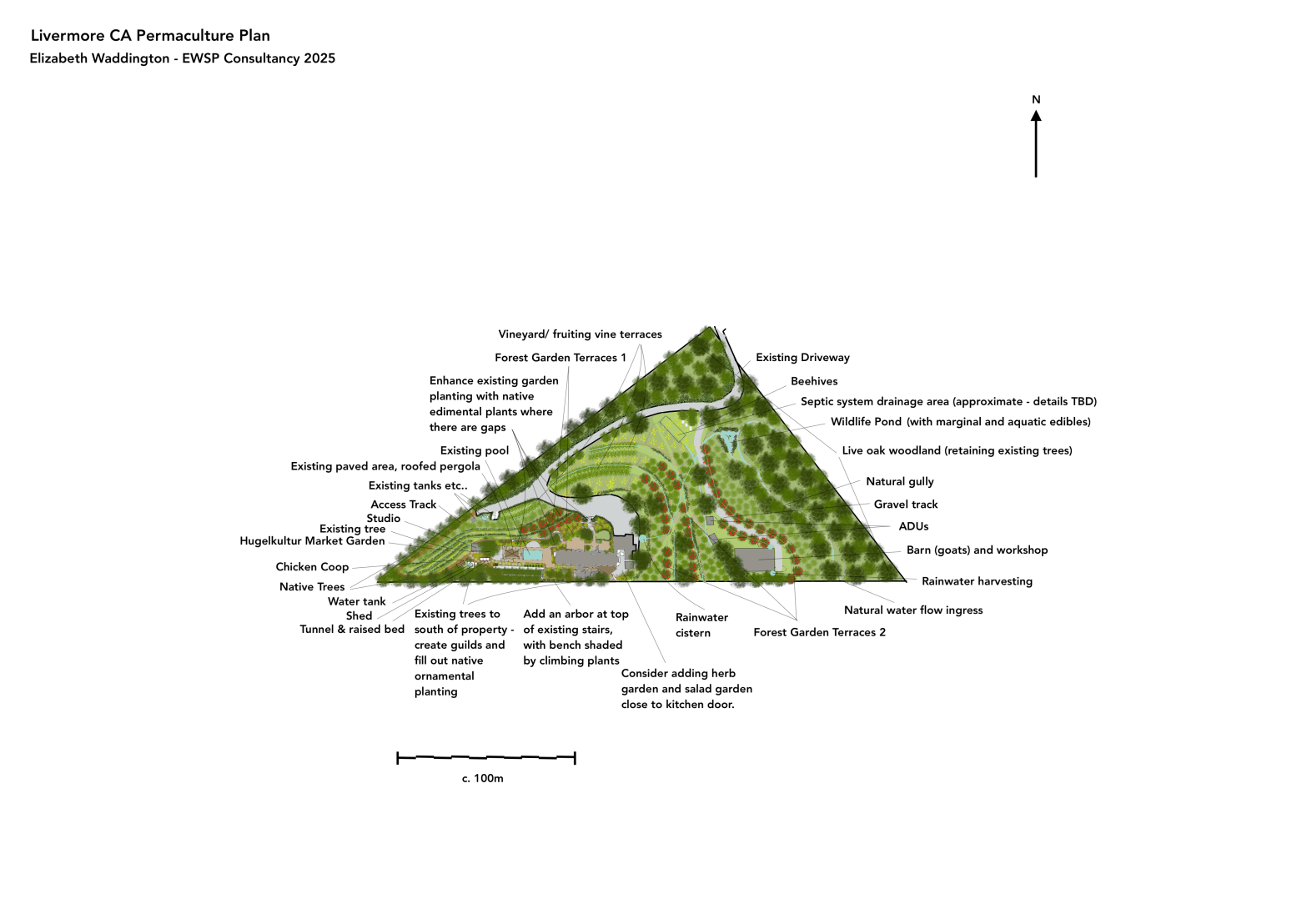
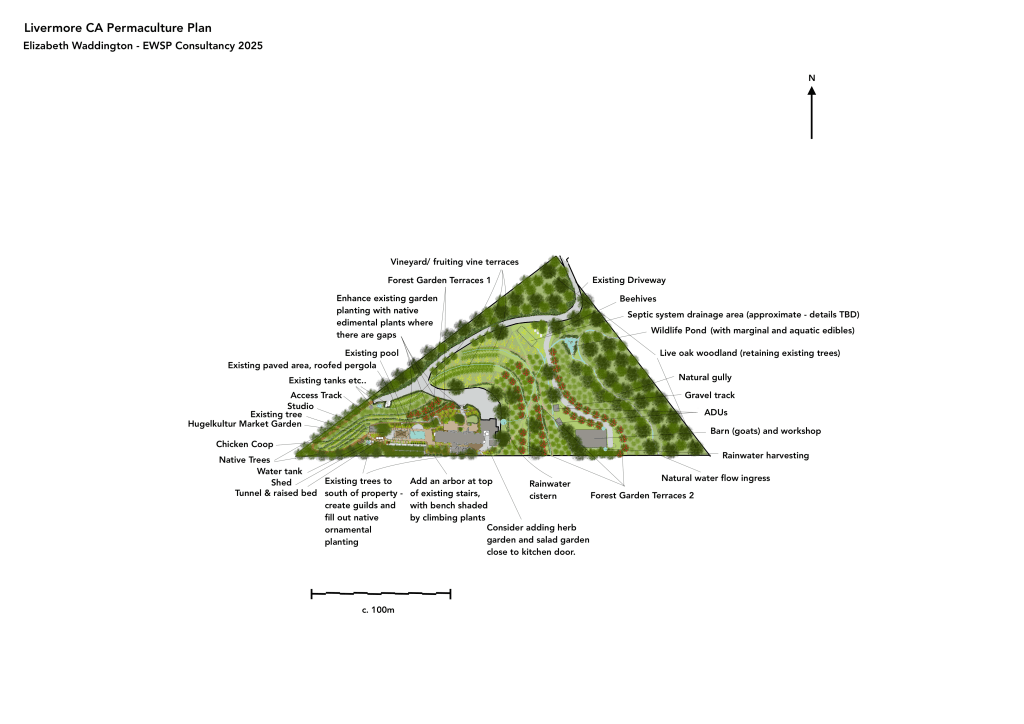
This concept design for a property in Livermore, California aims to provide plans for the creation of a beautiful, regenerative landscape that provides for many of the needs of the family who live here while also catering for wildlife and ecological health and improving the biodiversity of the site.
Ecoregional Design
Within the Livermore Hills and Valleys ecoregion of California, the site comprises a home and partially planted garden grounds, alongside grassy slopes and a few existing trees. This plan aims to significantly increase tree cover on site while also allowing for abundant food production and plenty of recreational spaces for the occupants to enjoy.
The Livermore Hills and Valleys ecoregion encompasses the Livermore, Amador, and San Ramon Valleys, along with the surrounding low hills. Much of the terrain is flat and primarily urbanized, resting on Quaternary alluvial deposits.
The nearby low hills, characterized by loosely consolidated Plio-Pleistocene sediments, are predominantly covered in grasslands, interspersed with occasional blue oak or coastal live oak. Elevations typically range between 300 and 1,100 feet.
The soil in this area exhibits thermic temperature regimes and xeric moisture regimes. During the summer months, streams in the region usually remain dry.
In zone 1, closest to the home, are existing areas of paving, an existing pool, and some planting, including planting of olive trees and other planting on a slope south of the dwelling and pool.
Planting for the slope to the south is to remain as existing, perhaps with the addition of further groundcover plants.
Zone two comprises hugekultur market garden areas, and terraced forest garden areas, verging into zone three with the addition of small vineyard zones and wildflower strewn grasslands.
If you are interested in a similar design for your own property, I would love to hear from you to discuss your specific site and needs.
Hugelkultur
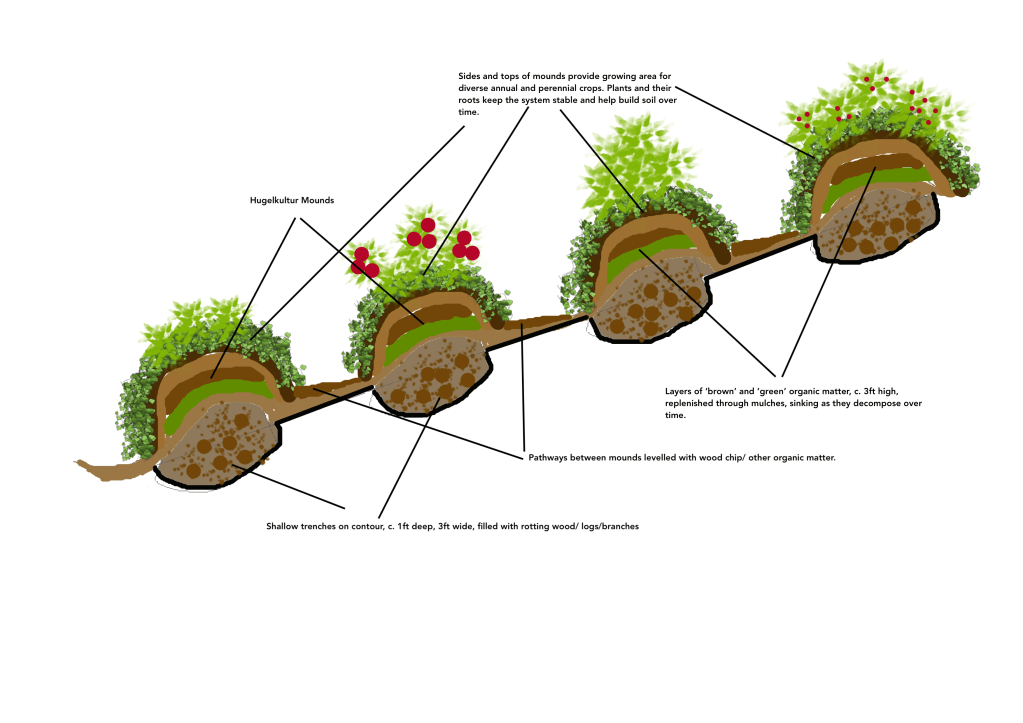
The hugelkultur system is designed to reduce water losses and allow for low-water use food production on a larger scale, beyond the raised beds in the vegetable garden area.
Some summer crops are suggested for this area, though there are of course a wide range of other common and less common crops that might be grown.
Successional sowing is essential with cover crops to make sure mounds are vegetated year round. I noted to the client that they should be used for fall as well as spring planting. I also urged them to consider rotation, especially of legumes.
Irrigation, when needed, can be provided by means of a drip system run from the hilltop water tank. But the hugelkultur system should reduce water needs.
Forest Garden Terraces

The forest garden terraces are another feature designed to reduce water losses and retain as much water as possible on the site in plants and soil through the driest months.
I have also suggested gravity-fed drip irrigation of this area from the cistern at the top (collecting rainwater from the home/ paved areas) for summer. Though forest garden systems should become more and more drought-tolerant and resilient over time, irrigation will be required for establishment and for most planting longer term in this region.
Beyond the main food producing zones are native woodland areas, around existing trees, and areas for regeneration including a pond. Benches, seating areas and pleasant pathways allow for enjoyment of the whole of the property.
Comprehensive Permaculture Design
I also provided the client with full planting plans for all the key growing areas, and provided some other additional information and detail as we proceeded with the full plans.
Though I do not share all details of specific designs on this site, the designs are more comprehensive as delivered to clients. I would be glad to share examples of designs beyond the concept plans with those who are interested in engaging me for their own design, to give a clear idea of deliverables.
 EWSP Consultancy