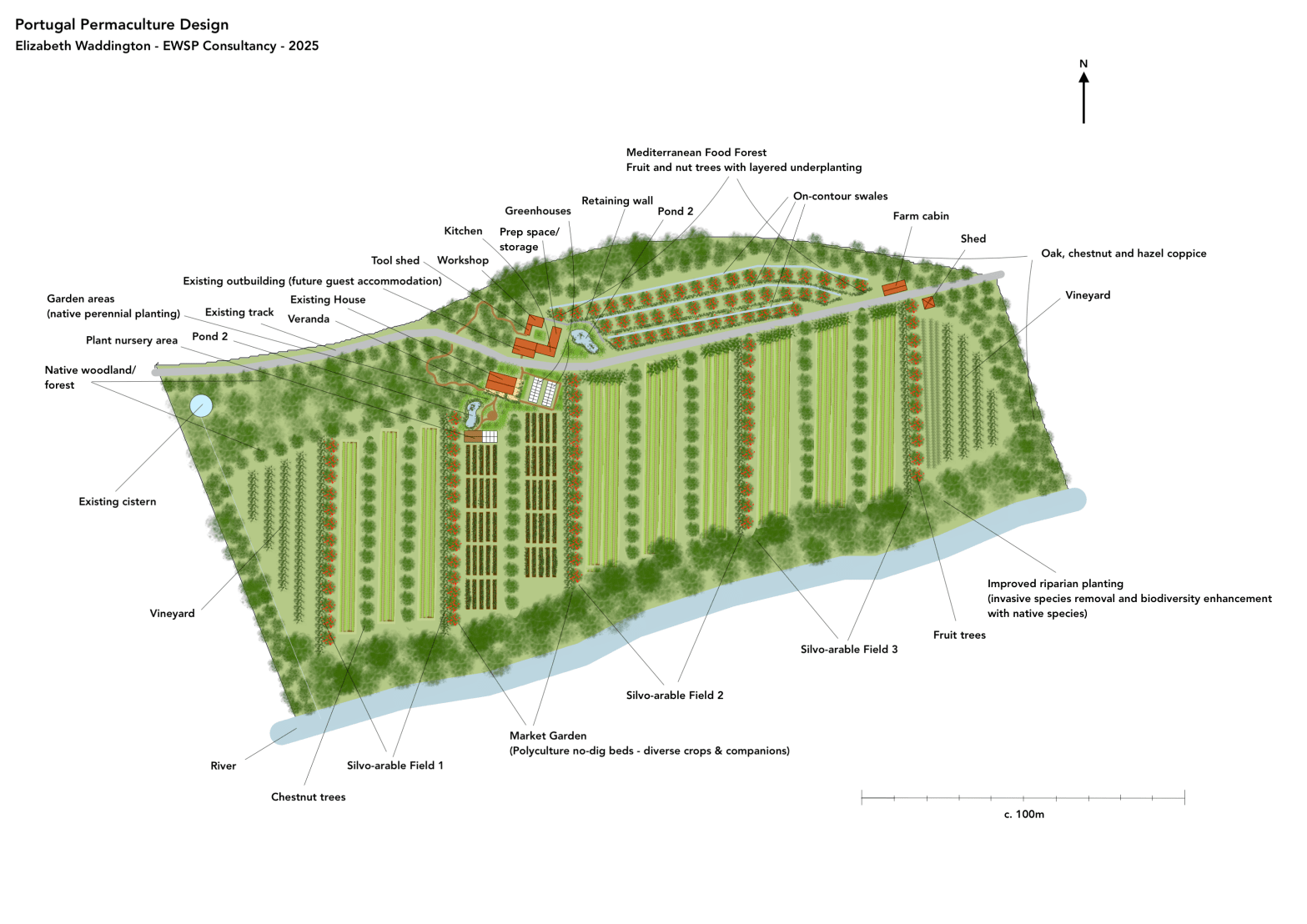

This case study outlines my comprehensive permaculture plan for a riverside property close to Coimbra, in Portugal. The design aims to regenerate degraded areas, enhance food security, diversify land use, and create a resilient, ecologically rich landscape that supports both productive agriculture and long-term environmental stewardship.
The project site features gently sloping terrain running down toward the river, with mixed existing vegetation, remnant woodland, and several historical features such as an old cistern and outbuildings.
From the outset, the design centred on integrating new systems with the site’s natural hydrology, microclimates, and existing structures. Careful attention was given to aspect, water flow, and soil-building potential to create a balanced mosaic of production spaces, habitat zones, and living areas.
Sustainable Food Production
At the heart of the property lies the main house, surrounded by a series of functional buildings including a workshop, tool shed, kitchen workspace, and prep/storage area. These form a compact service hub, reducing travel time between daily-use zones and ensuring that essential infrastructure is easily accessible. Adjacent to these, greenhouses and a plant nursery area support year-round propagation and seedling production, providing the backbone for the site’s ongoing reforestation, perennial establishment, and market gardening activities.
Immediately downhill from the central hub, a market garden with no-dig beds introduces a diverse polyculture system, designed to supply a range of fresh produce for personal use and local market sales. Companion planting, crop rotation, and soil-enhancing mulches work together to build fertility and maintain productivity without reliance on external inputs.
Surrounding the market garden, three silvo-arable fields combine rows of trees with annual cropping, offering shade, soil protection, and long-term yields of nuts, fruits, and timber while still accommodating arable production.
Higher on the slope, a Mediterranean food forest establishes a dynamic, multi-layered system of fruit and nut trees, shrubs, herbs, and groundcover species. Carefully placed swales contour the hillside, capturing runoff, reducing erosion, and infiltrating water into the soil throughout the year. This zone also incorporates ponds and retaining structures that enhance wildlife habitat and support irrigation resilience.
Regeneration Through Design
Existing woodland areas are preserved, but I have also suggested that they are enhanced with selective clearing, coppicing, and understory management. Native species regeneration is prioritised, while invasive species are gradually removed, especially along the river corridor. This improved riparian zone increases biodiversity, stabilises riverbanks, and strengthens the ecological fabric of the site. Additional orchards, vineyards, and chestnut plantings diversify the productive landscape and reflect local traditions.
Across the site, paths, tracks, and landform-responsive planting lines establish intuitive movement routes and aid in the long-term stewardship of the holding. An existing outbuilding is allocated for future guest accommodation, supporting the landowner’s intention to host workshops, volunteers, or eco-tourism visitors in future.
If you are interested in discussing a design including some or all of the elements in this permaculture landscape design for your own property, please get in touch.
 EWSP Consultancy