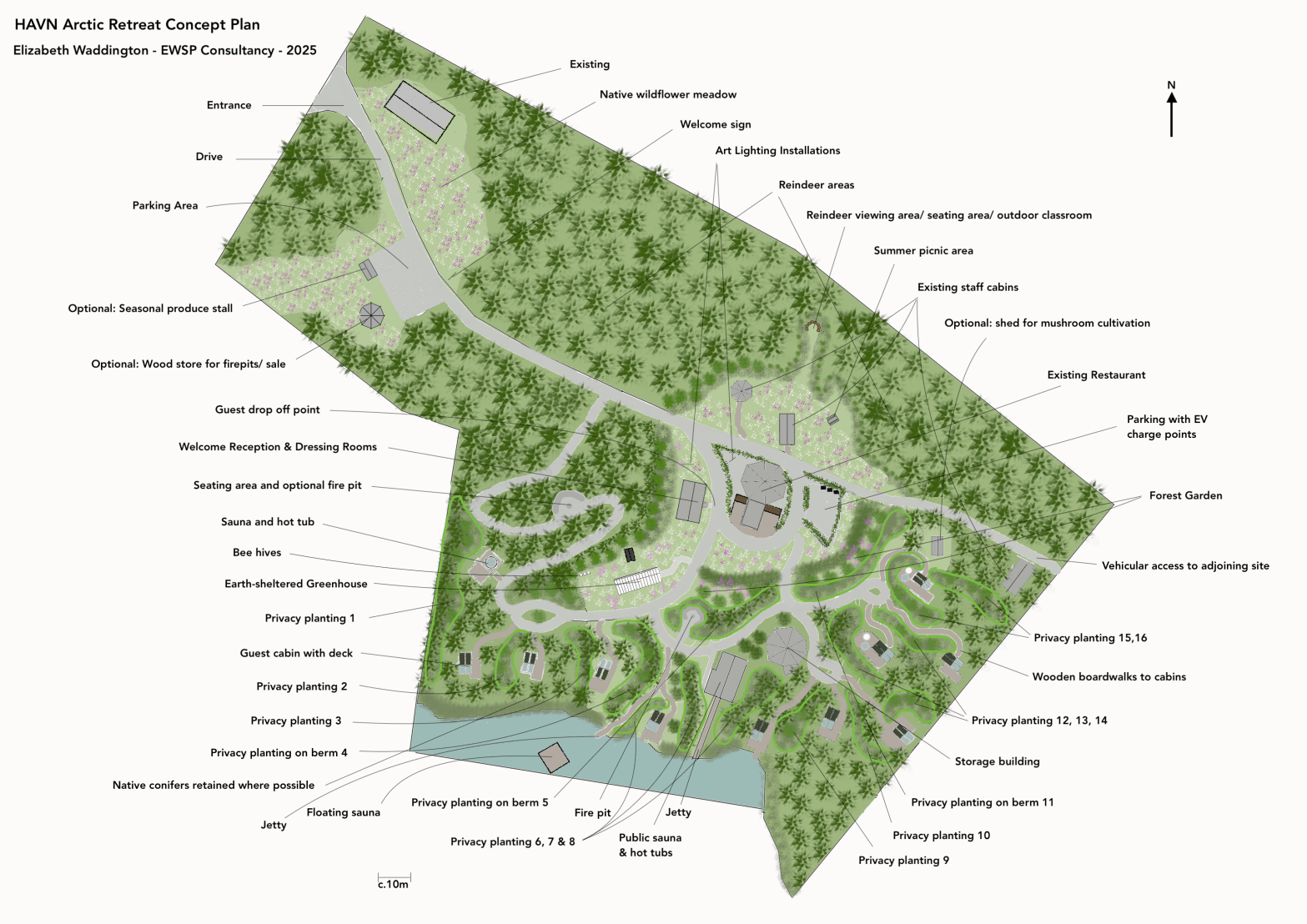

This is a design I created in the summer for a client creating an ‘Arctic Retreat’ just below the Arctic Circle in Arvidsjaur, Sweden. This is a challenging environment, though it can be a very beautiful one, in both summer and winter.
Located just below the Arctic Circle in northern Sweden, Arvidsjaur sits within the boreal forest biome and represents a unique context for cold-climate permaculture design. The landscape is defined by glacially carved terrain: a mosaic of taiga forest, peat-rich wetlands, and freshwater lakes. Soils are often acidic and nutrient-poor, particularly in forested areas, though more fertile alluvial pockets can be found near water bodies and historical settlements.
Subarctic Permaculture Design
The climate is subarctic (Köppen Dfc), characterized by long, cold winters and short, cool summers. Annual average temperatures hover below freezing for nearly half the year, with winter lows frequently reaching -25°C or lower. Snow cover can persist from October to May.
Summer temperatures rise modestly (typically 15–22°C), and the period of near-continuous daylight between May and July allows for rapid vegetative growth—provided varieties are adapted to the intense but brief growing season.
This resort will initially feature ten cozy cabins overlooking a tranquil lake framed by lush forest and scenic marshland. (with ten further cabins planned that will rest lightly on neighbouring land).
Designed for deep relaxation and connection with nature, each private cabin offers panoramic views and immediate access to the surrounding landscape.
Guests can unwind in saunas (including one floating on tranquil lake waters, and one up among the canopies of the trees), outdoor hot tubs, and fire pits. They can stroll or forage in beautiful natural gardens, or take part in a range of seasonal activities.
The particular focus for the client in this case was to ensure that each of the cabins was positioned to optimise views and privacy, and that the earthworks and planting around these cabins enhanced the environment for guests, while withstanding the harsh local conditions and working in harmony with the lake and other natural features of the area.
The concept plan involves the creation of berms and planting areas that increase privacy for cabin guests, and the beautification of current clearings in the native forest. It also suggests the enrichment of native forest zones with a greater diversity of native or naturalised plants.
The taiga forest at Arvidsjaur is primarily made up of spruce and Scot’s pine trees, with an understory of edible berries, primarily bilberries, with a few herbaceous plants, and areas of abundant wildflowers in forest clearings.
A Food Forest Based on the Taiga
Within the heart of the resort, I have suggested creating a small forest garden. Also known as a food forest, this is a strategy that can work even in more extreme environments with the right species.
For the canopy in this case, I have suggested birch, grey alder, Siberian pea shrub, rowan, cold-hardy apple (e.g. Antonovka?) (on dwarf rootstock)… (plus further experimental species and cultivars which may be possible)…
Below these, the food forest will mimic the natural environment of the area, with a diverse layer of edible berries, such as arctic raspberries, bilberries, crowberries, lingonberries and more…
Which will be diversified with native and climate-appropriate herbaceous perennials that can survive and thrive in the extreme conditions while also providing for human needs.
Food Production in Extreme Conditions: An Earth-Sheltered Greenhouse
In the challenging climate of Arvidsjaur—where winters are long, daylight is limited for much of the year, and frosts can strike even in late spring—an earth-sheltered greenhouse offers a powerful, low-energy solution for extending the growing season and improving food resilience. Also known as a walipini or pit greenhouse, this structure is built partially or entirely into the ground, using the Earth’s stable thermal mass to regulate internal temperatures naturally.
By harnessing the insulating properties of soil, an earth-sheltered greenhouse can maintain above-freezing temperatures even during the coldest months, while also significantly reduced heating input.
The design shelters plants from wind, snow, and rapid temperature fluctuations while capturing passive solar energy through a south-facing glazed roof. In Arvidsjaur’s environment, this allows for season extension by several months, and in some cases, year-round cold-hardy crop production.
I have recommended the use of certain strategies like adding thermal mass, and creating compost filled hot beds, to reduce or even eliminate the need for winter heating.
Full-spectrum LED grow lights are fairly economical to run and dramatically extend potential for production over the dark winter months.
Permaculture is about finding solutions for even the most challenging of sites or situations. No matter where you live, and what challenges you face, contact me to discuss how I can help, and for a bespoke quotation for design and/or consultancy services.
 EWSP Consultancy