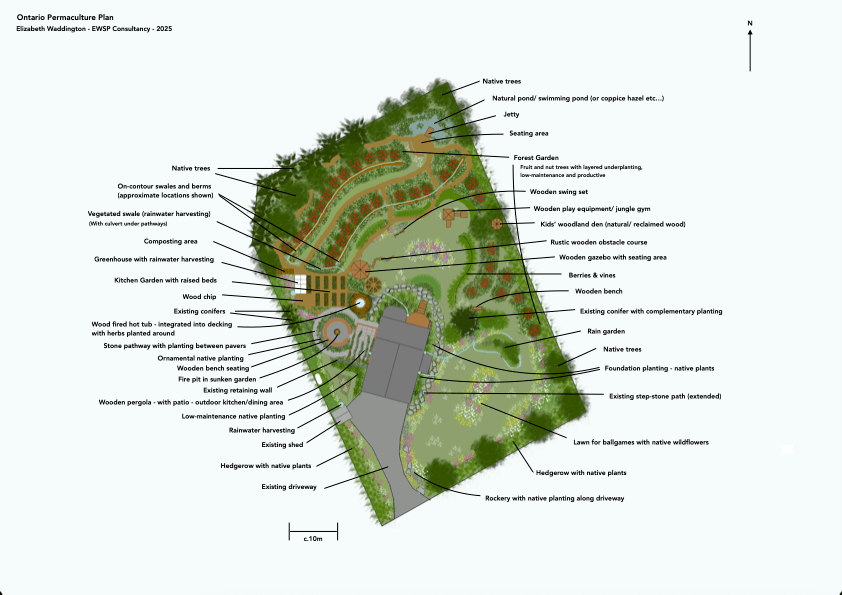
Another design that I worked on earlier this year, this permaculture garden design was created for a client in Prince Edward County in Southern Ontario, Canada.
This part of Ontario, located in Prince Edward County, has a humid continental climate with warm summers, cold winters, and notable influences from Lake Ontario that moderate temperature extremes and extend the growing season slightly. The area receives about 850–1000 mm of annual precipitation, well-distributed through the year. The location is USDA zone 5b to 6.
Soils around Bloomfield are predominantly shallow, calcareous, and stony due to the underlying limestone bedrock, often covered by a thin layer of clay loam or sandy loam glacial deposits. These soils are generally alkaline (pH ~7-7.5), moderately fertile, and well to excessively drained. However, their shallow depth can lead to moisture stress during dry periods, and stony/ gravelly areas may have low water-holding capacity and be prone to drought.
This plan takes into account the local conditions, and aims to provide plans for the creation of a relatively low-maintenance, productive and attractive family garden for a property used as a residence during the summer months.
Zone 1 – Outdoor Living Areas & Kitchen Garden
I have suggested that an existing step stone pathway is extended around the home to a new paved area/ patio to the west of the home. This area, to the west of the property, is the hub of new suggested outside living areas – with a climber-clad wooden pergola and an area below for cooking and dining.
Adjacent to this is a sunken fire pit and seating area, surrounded by a circular stone pathway. To the north I have suggested placing the kitchen garden area, with a greenhouse and raised beds, along with ornamental/ pollinator planting and a wood-fired hot tub integrated into a decked area with herb garden – growing common culinary herbs.
Beyond these areas, a gazebo provides a seating area to look out over other areas of the garden – wildflowers in a lawned area to the east (over the septic drainage system) with kids’ play areas/ equipment, and forest garden areas (zone 2) to the north and further east. An adjacent mandala garden provides a space where kids can learn to grow their own.
Zone 2 – Forest Garden
Forest garden areas are layered areas of planting designed to provide an abundance of food and other resources while also forming a relatively low-maintenance and ecologically functioning ecosystem over time.
In the forest garden area to the north of the plot, I have suggested planning planting around two on-contour swales (approximate locations shown but these should be created to follow contours on site).
Swales to be approximately 90cm wide and 30cm deep,mostly filled with organic matter. A berm should be created on the northern (down hill) side into which fruit trees and shrubs etc. should be planted.
A vegetated swale (same dimensions,though with a slight slope downwards rather than being on-contour) (with sections of conduit pipe below pathways) can link these swales with rainwater harvesting from the home. (I recommend planting up this vegetated swale with Elymus virginicus, Virginia wild rye, and native sedges.
I have also suggested creating a pond, to help with biodiversity and pest control in the forest garden, and to provide additional fun, beauty, and recreation for the family. This might also be a natural swimming pond for the summer months.
However, if a pond is not desired, I also noted to the clients that this area could be used for coppicing hazel and perhaps other native species.
Zone 3 and Beyond – Wildlife-Friendly Spaces
Lawns with wildflowers and other ornamental and wildlife friendly native planting, and the addition of a number of native trees and hedgerows around the edges of the garden round out this design, helping to improve biodiversity and therefore the resilience and low-maintenance nature of the garden.
In addition to providing the above, I also created full planting plans and a suggested implementation plan for these clients.
If you are interested in obtaining a similar plan for your own garden, either in Canada or elsewhere, please get in touch for a bespoke quotation.
 EWSP Consultancy