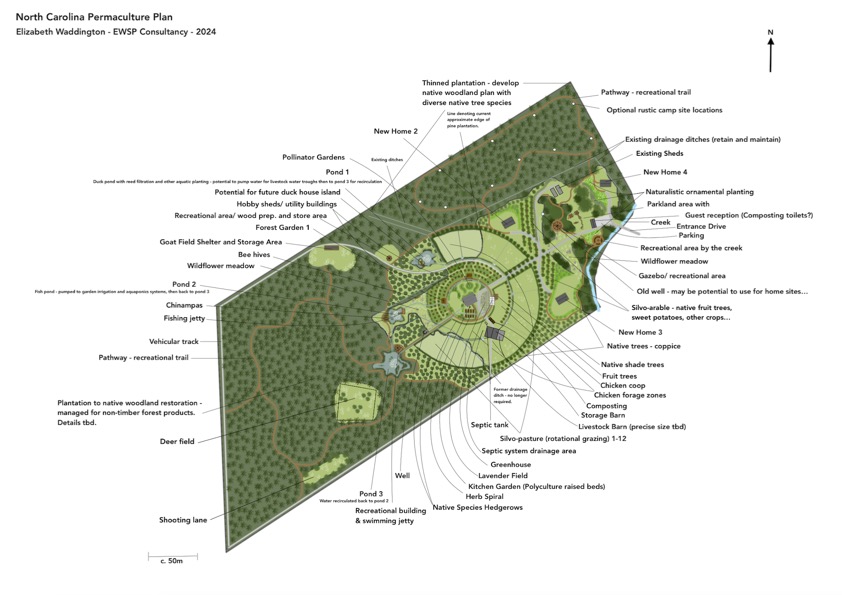
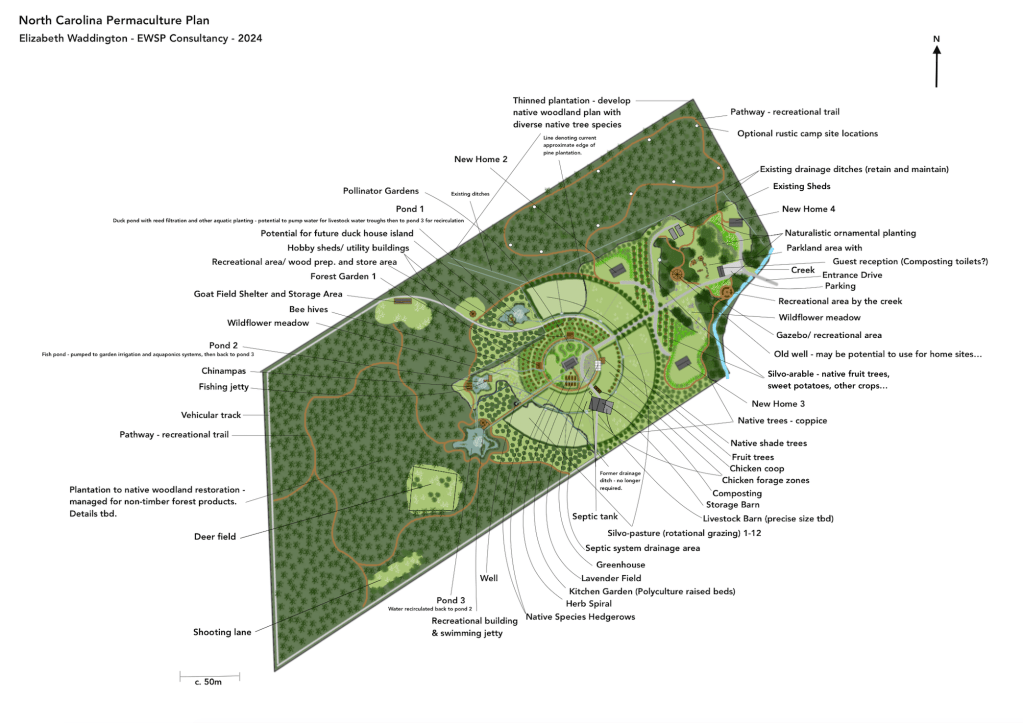
This design for a site of approximately 44 acres, 33 of which are currently plantation woodland that I created towards the end of last year.
I provided site plans to guide the formation of a sustainable, beautiful and productive homestead for the extended family, including planting schemes and plant lists, alongside the information given below:
Key Features and Planting Areas:
Home 1
Home 1 is considered to be zone 0 – the centre of operations for this project. Solar PV panels, rainwater harvesting, gray-water recycling and a sustainable septic system could potentially be considered as sustainable features for the property that is planned.
Zone 1:
Zone 1 contains the features visited most frequently from this home, that require the most time and attention.
Kitchen Garden
My suggestion for the kitchen garden was to create eight raised beds (hugelkultur or lasagna bed style) with reclaimed wood or upright log edging, approximately 1m wide and 4m long.
Herb Spiral
A herb spiral is an attractive and practical way to grow a range of herbs. The herb spiral should be around 1.5-2m in diameter, and around 1m high at the centre. I have suggested creating the structure with logs on end, cut to the required lengths. (Logs can be charred for longevity if desired.)
Pollinator Gardens
I suggested ornamental and pollinator-friendly garden planting for the area around the home.
Greenhouse (Aquaponics)
The idea is that water from Pond 2 will be directed to hydroponic growing systems in this greenhouse.
Lavender Field
This area I have suggested using as the requested lavender field – for visual and olfactory appeal from the home, and the potential to harvest lavender to use in a range of different ways.
It can be used for household floral displays, in pot pourri/ sachets for clothes drawers etc, in cooking/ baking, to make soaps and other cleaning and beauty products, in infused oils etc… essential oil might also be distilled and used for a range of purposes in herbal crafts and herbal medicine.
Recommendation: Space lavender plants 30-40cm apart, on ridges around 45cm apart. Select different varieties to grow. Consider planting other companions alongside lavender, including other Mediterranean herbs, Alliums for pest control…etc…Note: Lavender essential oil may deter mosquitoes (though likely not while in active growth, only when extracted and concentrated).
Native Species Hedgerows
Suggested native plants for mixed native hedgerows.
Zone 2:
Pond 1
This pond might be used for ducks, with an island and duck house. I have suggested planting to filter water (and withstand ducks feeding) for this pond, so that the water can be directed from here to livestock water troughs, then potentially to pond 3 for recirculation. (Solar pumps suggested to circulate the water.)
Pond 2
This pond I have suggested for use as a fish pond, with chinampa-style growing areas and adjacent bog garden (with some edible plants). The nutrient-rich water, I have suggested directing (as part of an aquaponic system) to the greenhouse (hydroponic growing) and to irrigate the kitchen garden (drip irrigation), before recirculation back to pond 2 via pond 3.
Pond 3
This pond is a wildlife-friendly pond which could also be used for recreation and ‘wild’ swimming if desired. I recommended using solar powered pond aerators. though planting will also play an important role in keeping water clean and clear.
Forest Garden 1
Forest garden 1 is a forest garden requiring a little more attention due to the inclusion of a number of non-native fruit tree species in addition to a number of native plants. The plants suggested for inclusion are designed as a starting point, to which additional lower- layer species might be added over time.
Bee Hives & Wildflower Meadow
Suggested location for bee hives is to the northern side of an area of wildflower meadow. Native plant wildflower meadow mix suggested.
Native Shade Trees (Deciduous)
Areas with shade trees would be low maintenance, though of course could also be managed for a range of non-timber forest products. Species I recommended using included
- Acer rubrum – red maple
- Carya glabra – Pignut hickory
- Celtis occidentalis – Hackberry
- Fagus grandiflora – Beech
- Juglans nigra – Walnut
- Liriodendron tulipifera – Tulip tree
- Quercus alba – White oak
- Tilia americana – American linden
Chicken Forage Zones
I have suggested placing a chicken coop adjacent the greenhouse with an easily accessible egg collection outside the suggested hedge.
Suggested fruit tree species for this area (native species – low maintenance):
- Amelanchier arborea – Downy serviceberry
- Castanea pumila – Chinquapin
- Diospyros virginiana – Persimmon
- Morus rubra – Red mulberry
Composting
I suggested creating a three-part cold composting system with wood pallets, that can be accessed at times by the chickens from one side and from the access track from the other.
(I also suggested doing smaller -scale composting close to the home – e.g. vermicomposting – but this would be for manure/ larger-scale farm composting.)
Zone 3:
This zone encompasses lower-maintenance and larger-scale agroforestry systems, including the small rotational grazing fields and silvo-arable system in which sweet potatoes and other crops if desired can be grown between native fruit and nut trees.
Silvo-pasture (Rotational Grazing) 1-12
I suggest using movable electric fencing to create 12 small fields/ paddocks approximately as shown within the area defined by mixed hedgerows. Livestock can be moved regularly on a frequent rotation through this area so that the sward is maintained. (Seed with a mix of native grasses, legumes and forbs for good nutrition etc…)
This area I suggest planting with tree rows approximately 10m apart, between which rows of sweet potatoes, legumes, and other crops can be planted. There is also potential to introduce grains to this area if desired in future in rotation with other arable crops.
Wood Prep and Store Area
I suggested creating a store and wood-store areas to manage wood from the property for a number of different uses. This can also be a recreational area to enjoy the tranquil woodland surroundings, and might also be used for shredding woody material, and potentially making charcoal/ biochar and other such activities.
Zone 4/5:
These are less-managed zones with a range of purposes within the existing tree-covered areas of the property.
Goats (Woodland – Rotational Grazing)
A shelter for goats and moveable fencing/pens would enable goats to be used to maintain biodiversity within woodland areas rather than reducing it. Goats foraging can be carefully managed alongside planting for restoration of native plant layers slowly over time as long as stocking numbers are not too high.
Native Tree Coppice
Many native tree species can be used for shorter and longer term coppice. I suggest choosing a variety of species – some coppiced on a fairly short rotation, some on a much longer one… this is a sustainable way to obtain timber and wood for a range of uses without clear-felling.
Plantation to Native Woodland (Managed for NTFPs, with recreational zones.)
Slowly manage tree-cover, opening up in places and planting to boost biodiversity to create a natural, balanced ecosystem that can provide a wide range of resources.
Secondary Centre – Park Land Area
A secondary centre of operations centres on the park land area towards the entrance of the property. Here, several key recreational zones and guest-facing facilities are suggested, along with some additional planting of native tree species. (Existing structures to be retained and planted around with more native trees).
Guest Reception (Composting Toilets) & Parking
A small building here, beside a parking area to potentially house a small reception/office and composting toilets for the use of rustic campsite guests.
Recreational Area By the Creek
An area with native planting (like pollinator garden) adjacent to an area for picnicking/ a fire pit/ BBQ ares and seating overlooking the creek.
Gazebo & Kids Play Area
An area for the enjoyment of the parkland area and kids’ entertainment.
Rustic Camping Sites & Recreational Trail
Potential to create small clearings for tents or other basic camping structures to welcome guests in future.
Gardens for Homes 2, 3 and 4
For the planting adjacent to each of the further homes, when these are ready, I suggested a low-maintenance mix of edible and ornamental/ pollinator attractant native plants.
The above gives a small taste of the information delivered along with the visual aspects of a full design. If you would like to know more about the above, or would like to discuss a comprehensive design for your own property, please get in touch.
 EWSP Consultancy